The Lardner Report

Unleash your creative superpowers!

  • Home
  • Creative Voltage Website
  • Contact
  • Archives
  • About

Art’s Most Seductive Disappearing Act

September 30, 2017 by Lonnie Lardner

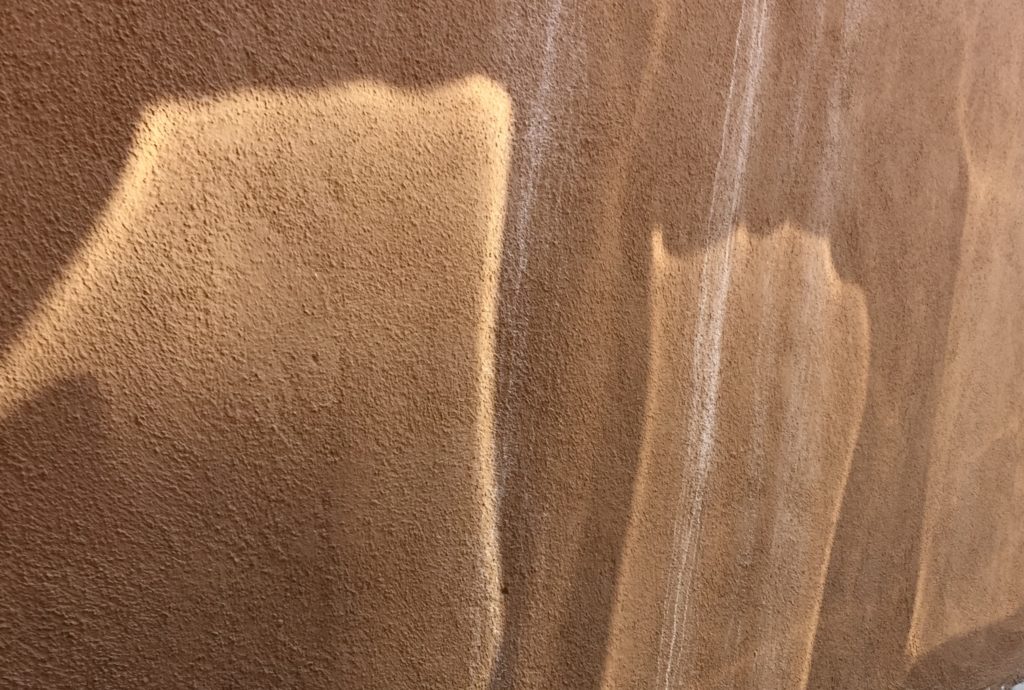
(Pic #1) Detail, reflection of a Chevy truck door on my hair salon wall. Woodland Hills, CA.

Now you see it, now you don’t.

Sometimes I think ART is messing with my head. It’s always when I least expect it — something catches my eye walking to or from an appointment. This time I was on my way to Salon Sirenetta for a haircut and highlights (not exactly critical to the story, but nonetheless) when shiny, tombstone-like  patterns on the parking lot wall jumped out at me. (Pic #1)

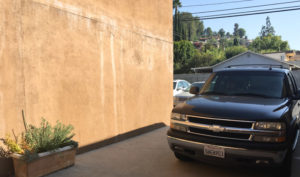
(Pic #2) Minutes later — the art had vanished.

I couldn’t tell if they were caused by a funky paint job, or maybe a gifted local muralist. Upon further inspection, I saw that they disappeared when I walked by. Light bouncing off a big black truck door was causing all the hubbub, and I played with the shadows and reflections until I was satisfied that was the source.

Art can be transitory, sildenafil fleeting, and when it’s really on its game — a big tease. With the shifting of the sun, the patterns above just lasted a matter of minutes — and by the time I left the salon, the whole work of art was gone. (Pic #2)

Despite its trickery, or maybe because of it, I find this kind of interplay exciting. There’s something about savoring an ever-so-brief moment like this that stirs up my own artist within.

It reminds me of the “zen” experience of painting on a Buddha Board. As you see in the video above,  you paint with water — so your designs disappear in a matter of seconds. The practice is a great exercise in connecting with the present, and not being obsessed with outcome. Process — not product. The work you paint now, will soon be a memory. There is no time to get attached or judge your results. It’s the ultimate lesson in “letting go.”

Filed Under: Found Art Tagged With: Buddha Boards, disappearing art, murals, not product, process, transitory art, vanishing art, zen experience

Grand Central: Finding A Masterpiece in the Belly Below

July 31, 2017 by Lonnie Lardner

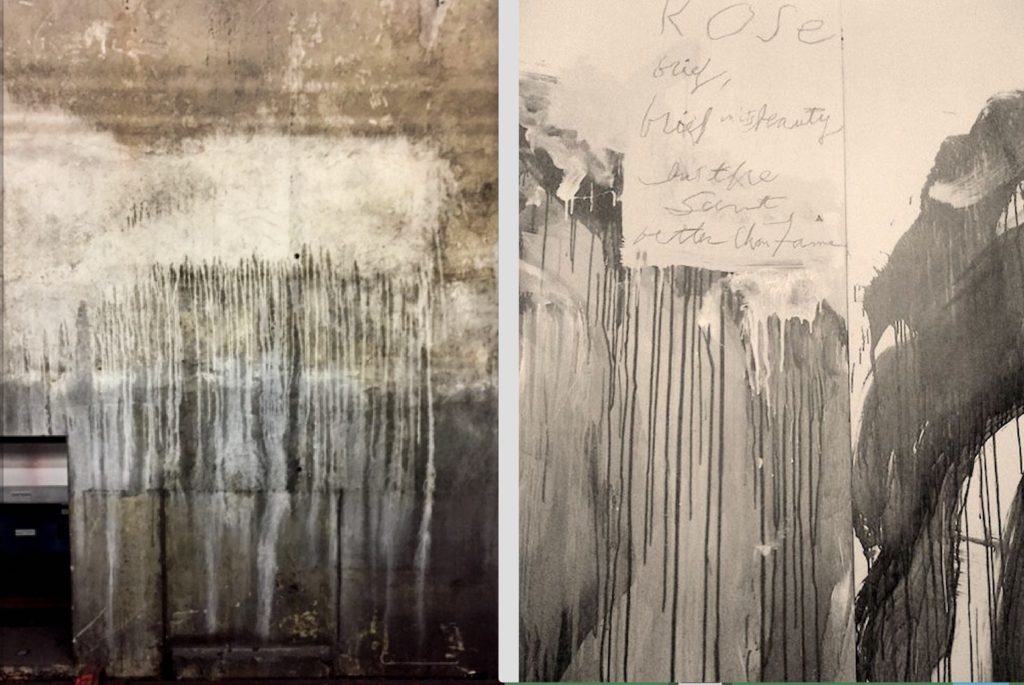
(Pic #1) Left: Cement wall flanking Track 126, Grand Central Station, NYC. Right: Multi-million dollar drip painting with notes, by iconic American artist Cy Twombly (1926-2011).

Unexpected art in the bowels of the world’s most storied station.

It happens to me all the time. I find myself whining about the heat or the physical challenges of navigating the city, and WHAM — the universe tosses a stunning little visual treat my way.

Taking the Metro North up to Westport, Connecticut, I was in one of those moods. The sweltering heat was making me cranky, and my train was leaving from what seemed like the grossest, stinkiest, deepest underground level in the terminal.

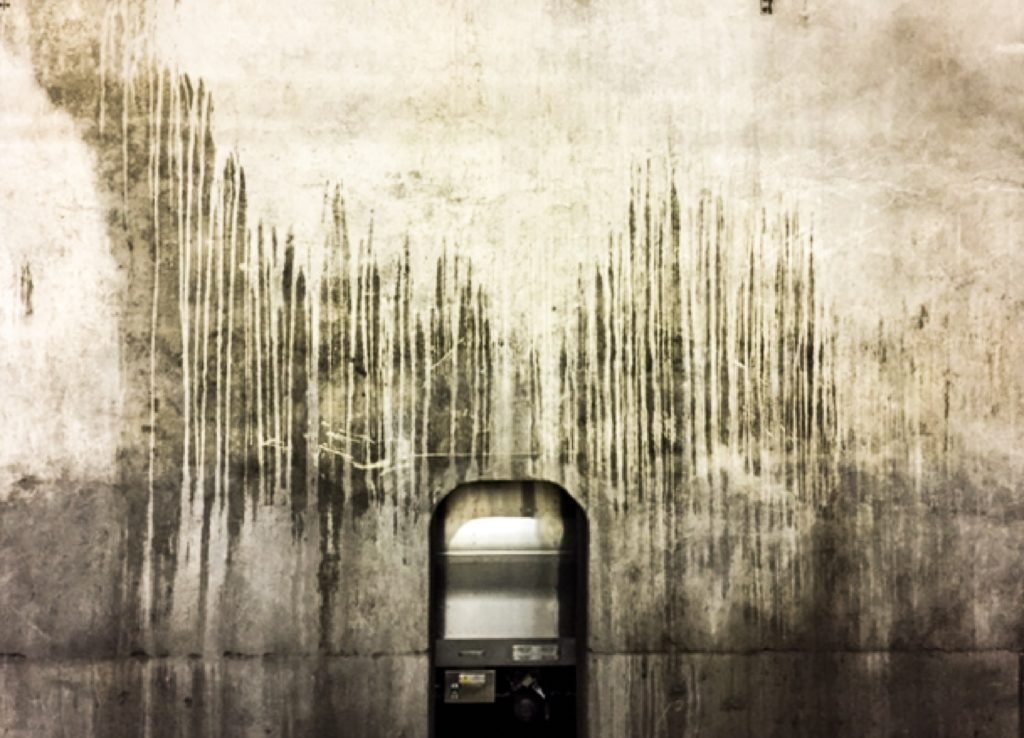
Then I suddenly noticed the half-washed walls, layers of soot, and general urban decay finasteride surrounding me.  It wasn’t gross at all — it was stunning. The lack of maintenance and cleaning left patterns of black and white, drips and stains from mold and old paint. Vertical lines from moisture and wear-and-tear. Lovely marks that referenced one of my favorite abstract painters, Cy Twombly. (Pic #1 – right).

I recorded these “museum walls” with my iPhone, and suddenly realized I had one of the best days in NYC in years. So, the biggest secret about Grand Central isn’t the secret sub-basement, (that the Nazis nearly destroyed) but the surprises left on the walls —  from nothing more than neglect. Sometimes art reveals itself in the strangest ways…now if only we could be ever so slightly more aware of its playful intent.

Filed Under: Found Art, Travel Tagged With: art is everywhere, art on the train tracks, art underground, Grand Central Station, street art, unexpected art

Catalina Island: A Visual Gem

May 31, 2017 by Lonnie Lardner

(Pic #1) View of Avalon Bay, and its world famous casino, Santa Catalina. Photo by Josh Kaplan.

And it’s just an hour away…

(Pic #2) Art deco mural in entrance to casino

I’ve lived in Los Angeles for 30 years, and I never made it over. Can’t explain it. But my niece Kyle decided to celebrate her 30th birthday there, and that was impetus enough to give it a go.

Its beauty and Mediterranean feel draw over a million visitors a year. The water’s edge appears emerald green, and then it eases into a soothing pure blue. The stark white architecture of the island’s historic casino catches your eye as you disembark. Inside, you’re met with stunning art deco murals and 1920s interior design. If you explore the island a bit, you’ll encounter one stunning scenic view after another.

These might be the attractions that draw the most visitors. But it’s the underbelly of any destination that’s appealing to me: the wear-and-tear, the urban decay, the ravages of saltwater eroding the ports, docks, and sea walls. I guess I’m more drawn to the “abstraction” of something, rather than the literal impression. Check out the photos we grabbed from exploring “the other side” of the island and the Port of San Pedro (below).

(Pic #4) Side of tanker, cipro Port of San Pedro.

(Pic #5) Side of tanker, Port of San Pedro.

(Pic #6) Weathered wall, Avalon.

(Pic #7) Container ship bumper, Port of San Pedro.

(Pic #8) Salt-weathered cement wall, Port of Avalon.

(Pic #9) Art-deco ceiling, Casino entrance, Avalon.

A little island history:

Amazingly, the island has been inhabited for at least 8000 years. At the time of first European contact in 1542, it is thought that the Native Americans living on Santa Catalina called their island “Pimu.” In more recent years, Catalina was owned by William Wrigley, Jr. of Wrigley chewing gum fame. He developed Avalon as a resort island and brought the Chicago Cubs (which he owned) there for spring training from 1921-1951.

The Island also served as a location for many of the movies filmed in the early days of Hollywood. In fact (you may have heard this one) one of the features filmed in the 1920s brought 14 bison to the Island and left them there. Now a herd of about 150 bison roam the Catalina’s interior. In the 1970’s Wrigley deeded 88% of the Island to the Catalina Island Conservancy. It remains undeveloped and wild.

Heading back soon.

(Pic #9) A 10-minute golf cart ride up the mountain to spectacular view of Avalon.

Filed Under: Found Art, Travel Tagged With: Abstract art, art from erosion, art is everywhere, Avalon, Catalina, Port of San Pedro, unexpected art

  • « Go to Previous Page
  • Page 1
  • Interim pages omitted …
  • Page 5
  • Page 6
  • Page 7
  • Page 8
  • Page 9
  • Interim pages omitted …
  • Page 21
  • Go to Next Page »

Subscribe here:

Categories

  • Art Table Tips
  • Artist Spotlight
  • Creative Zone
  • Eco-Art
  • Found Art
  • Newsmakers
  • Quotes
  • Reflections
  • Travel
  • Uncategorized

Archives

Hey Brubeck, Take THIS.

The Alien And The Volcano: Why Do Our Brains Need to Make Order Out of Chaos?

Wait — So How Do YOU Choose a restaurant?

Meet Creative Voltage!

Sometimes Your Cat Just Makes The Art FOR You

2026: Kicking Fear to the Curb

Choosing Gratitude. But for a paintbrush?

Every Page Is A Treasure: Discovering Plastikcomb

Calling all artists — INKTOBER is here! Whaaaaa?

Art From The Ashes

One Click — One Masterpiece?

When Art F*cks With Your Head

The Perfect One-Liner

Portland: A Tale Of One City – Through Two Lenses

Happy New Year!

Allowing The Moment To Emerge

How Can A 5-Year-Old Be My Muse?

Stunning, Simple Beauty

An Unexpected Collaboration With Nature

Pathetic Shoe Obsession: WTF?

Copyright © 2026 · Dynamik-Gen on Genesis Framework · WordPress · Log in