The Lardner Report

Unleash your creative superpowers!

  • Home
  • Creative Voltage Website
  • Contact
  • Archives
  • About

An Eye for Dirty Art

March 28, 2011 by Lonnie Lardner

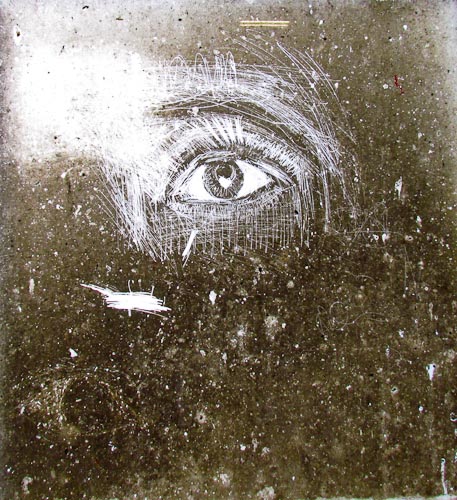
(Pic #1) The artist's eye: finding magic in the mundane

How one devoted artist showed me how to really seize the moment
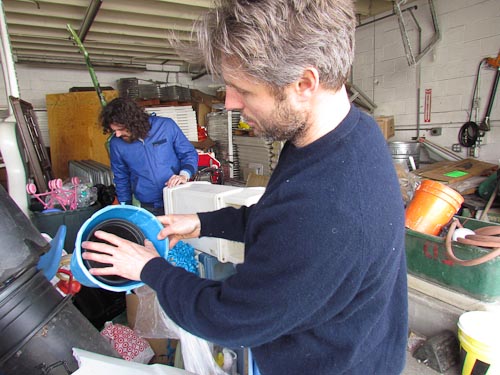
(Pic #2) Deininger: "Talking trash"

This week, I’m working on a mural for the City of West Hollywood, with a world-class environmental sculptor named Tom Deininger. He makes stunning wall reliefs out of consumer trash. Today we stopped by a sprawling city “dump” to root through garbage and tossed plastics Deininger needed to complete the piece. (Pic #2)

Immersed in the debris, and pressed by a tight schedule, Tom stopped in his tracks to tear across the warehouse floor to get a closer view of a filthy, rather unspectacular window. It had a gooey film of thick brownish gray residue from corner to corner.  And it was peppered with splotches and scratches cipro that let light seep through in interesting patterns.

Tom couldn’t wait to break out his own pen, turn it upside down, and start scratching his own design into this “blank canvas” of pure dirt. He just started sketching a pair of eyes he would later use for his mural design. (Pic #1)  I was inspired by his childlike enthusiasm to simply create.

He told me he just has “a peculiar instinct” to see the beauty in everything. It’s that fresh approach to familiar or ordinary surroundings that I adore. I’m convinced it’s what defines a true artist. But it’s my contention too, that we are all equipped with the those perceptual powers — as long as we are willing to allow them to interrupt our day.

“It’s not what you look at that matters, it’s what you see.” — Henry David Thoreau
Filed Under: Creative Zone Tagged With: an artist's eye, Eco-Art, environmental artist, painting on glass, seeing beauty in ordinary things, seizing the moment, Tom Deininger

French Girl Rewrites Classic Children’s Story

March 17, 2011 by Lonnie Lardner

Toddler improvises radically new version of Winnie the Pooh

Next time you’re creatively stuck — consider the unabashed creative license this little girl, “Capucine” takes with this children’s classic. Her rendition has made You Tube and countless other pop video sources.  She happens to be beyond adorable, but she reminded me what it takes to be truly, authentically creative. It’s not just imagination, nor a child’s innate, unbridled sense of play. I believe it comes down to one thing: fearlessness — a quality that allows kids to create something out of nothing — with no rules — because they don’t care what you think.

Creativity is often defined as “the production of something ventolin original or useful.” According to a recent article in Newsweek, “To be creative requires divergent thinking (generating many unique ideas) and then convergent thinking (combining those ideas into the best result).” And a recent IBM poll of 1,500 CEOs identified creativity as the No. 1 “leadership competency” of the future. So consider this:  your 3-year-old already has the goods.

Now enjoy the new and improved Winnie the Pooh — the one with crocodiles, ghosts, giraffes, and the hippo allergic to magic. It’s time you heard the truth.

“Every child is an artist. The problem is how to remain an artist once we grow up.”  — Pablo Picasso

Filed Under: Creative Zone Tagged With: adorable children, French girl reads Winnie the Pooh

“Think Outside The Box” — Who Came Up With This One?

March 6, 2011 by Lonnie Lardner

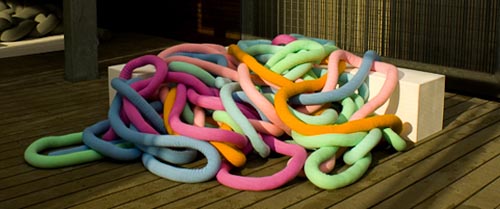
(Pic #1) "Outside the Box" Furniture Design: by Bauke Knottnerus

The origin of this well-worn phrase dates back to a brain game invented almost a century ago

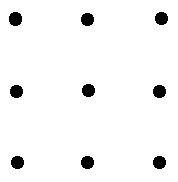
I get asked about this phrase all the time in my corporate wokrshops. The reference, it turns out, is quite literal. The “box” they were talking about was actually a 2-dimensional square made up of nine small dots. (Pic #2) The image appeared in Sam Loyd’s Cyclopedia of 5000 Puzzles, Tricks, and Conundrums in 1914.  Instructions read this way:

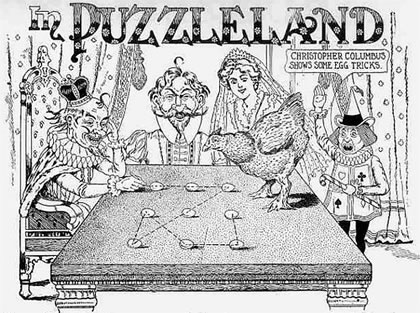
(Pic #3) Nearly 100 years old: Sam Loyd's Egg Puzzle

“Draw a continuous line through the center of all the eggs so as to mark them off in the fewest number of strokes.”  Loyd was apparently a little sloppy with the game’s rules and probably should have added that the lines must be straight, although he did supply an illustration that makes the meaning clear. (Pic #3)

(Pic #2) Nine dot puzzle: Click on dots for animated solution.

Simply put: Without letting your pen leave the paper, draw four straight lines through the nine dots. If it’s your first time, you might assume you are bound by an imaginary square or flattened box. But that perception leads nowhere. No matter how many times you try to draw four straight lines without lifting your pen, a dot is always left over.

What if….

This is where creative xenical thinking comes into play. “What would happen if I extend one of these lines beyond the box?” What happens — is the solution. (Click on dots on the left.) There’s even more than one  way to win (Pics #4 & #5).

(Pic #5) Puzzle solution #2

In the 1960s and 70s, business consultants resurrected the old Nine Dot Puzzle as a test for corporate trainees.  The “box” – with its elements of rigidity and squareness –  symbolizes constrained and unimaginative thinking. This is in contrast to the open and unrestricted  “outside the box” or “blue-sky” approach to problem-solving.

(Pic # 4) Puzzle solution #1

Quite often, creativity trainers won’t mention to their groups that they are allowed to extend their lines outside the box. Once they hear they were allowed, the trainees protest that it’s not fair — and typically the presenter will respond by saying, ” I didn’t tell you you couldn’t go outside the box.”

What is this fear?

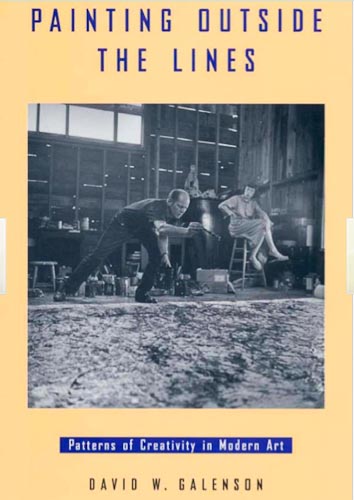
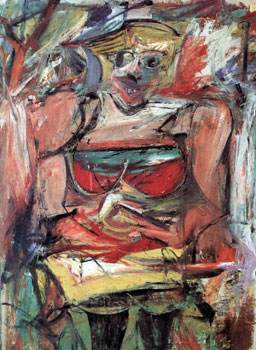
Why wouldn’t we naturally explore the outer limits of this open square? I suspect that it calls up our childhood sense of obedience when we were repeatedly told to color “inside the lines.” When I think of this notion, I am grateful that the little Jackson Pollock, Willem de Kooning, and Robert Rauschenberg had other ideas. 

(Pic #6) de Kooning, "Woman V" 1953

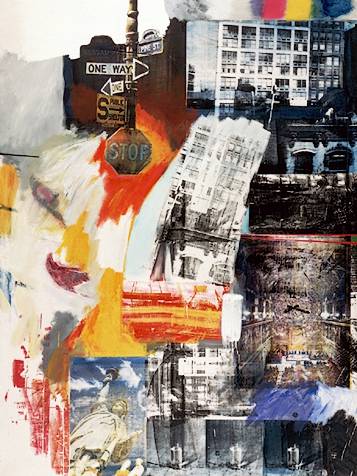
(Pic #7) Robert Rauschenberg (1925-2008)

Filed Under: Creative Zone Tagged With: brain game, brain teaser, coloring inside the lines, corporate catch phrases, corporate creativity, corporate training, creative thinking, egg puzzle, Jackson Pollock, outside the box thinking, painting outside the lines, Robert Rauschenberg, Willem de Kooning

  • « Go to Previous Page
  • Page 1
  • Interim pages omitted …
  • Page 71
  • Page 72
  • Page 73
  • Page 74
  • Page 75
  • Interim pages omitted …
  • Page 85
  • Go to Next Page »

Subscribe here:

Categories

  • Art Table Tips
  • Artist Spotlight
  • Creative Zone
  • Eco-Art
  • Found Art
  • Newsmakers
  • Quotes
  • Reflections
  • Travel
  • Uncategorized

Archives

09/27/2026 Los Feliz Wild Art Junk filled truck

Art? Or, Reflection Of My Mental Instability…

Hey Brubeck, Take THIS.

The Alien And The Volcano: Why Do Our Brains Need to Make Order Out of Chaos?

Wait — So How Do YOU Choose a restaurant?

Meet Creative Voltage!

Sometimes Your Cat Just Makes The Art FOR You

2026: Kicking Fear to the Curb

Choosing Gratitude. But for a paintbrush?

Every Page Is A Treasure: Discovering Plastikcomb

Calling all artists — INKTOBER is here! Whaaaaa?

Art From The Ashes

One Click — One Masterpiece?

When Art F*cks With Your Head

The Perfect One-Liner

Portland: A Tale Of One City – Through Two Lenses

Happy New Year!

Allowing The Moment To Emerge

How Can A 5-Year-Old Be My Muse?

Stunning, Simple Beauty

An Unexpected Collaboration With Nature

Copyright © 2026 · Dynamik-Gen on Genesis Framework · WordPress · Log in