The Lardner Report

Unleash your creative superpowers!

  • Home
  • Creative Voltage Website
  • Contact
  • Archives
  • About

A Boy Who Channels A Master — from the 50s

October 31, 2022 by Lonnie Lardner

(Pic #1) Laser-focused artist “Jaylen” splatters his way to a perfect abstraction. Hope’s Nest Halloween Workshop, Van Ness Recreation Center, South Los Angeles. 

He just started splashing paint around…

It caught my attention — especially since most kids are compelled to “stay within the lines” and to make art that “looks like something.” It’s just how most teachers steer them. They are often taught to copy — to draw with precision — the object in front of them.

Then there’s Jaylen. A young man who stopped by our Halloween Art Workshop in South L.A. and spun my head around. I asked if he knew about abstract expressionism and had he heard of Jackson Pollock. He said, “This IS Jackson Pollock.” I quickly shut my mouth, and silently thanked the teacher who took the time to introduce him to one of my fine art heroes.

Not only did he know one of the greatest painters in modern art, he knew at that moment, to be true to Pollock’s explosive style, he had way more splattering to do. He wasn’t finished. He had at least “one more coat” of black to apply before he could dry his thickening masterpiece in the sun.

His work would take longer to dry than any other child’s at his table, but he probably knew that Pollock would often have to wait a month for his paintings to cure.

Filed Under: Artist Spotlight, Creative Zone Tagged With: Abstract art, abstract expressionism, benefits of art, Halloween painting, inner-city arts, Jackson Pollock, kids' art, Kids' painting, splatter painting

Today’s Pic: Chaos Can Be A Beautiful Thing

July 31, 2014 by Lonnie Lardner

SD truck junk 4tlr -3 copy

(Pic #1): Treasure on a Truck

On a recent excursion from Los Angeles to San Diego, I drove by what appeared to be a chaotic payload of pure junk. But after closer examination, it turned out to be a very sweet visual treat. I begged my husband to slow down so I could grab the iPhone and shoot the fleeting work of art. (Pic #1)

I’ll never know who the driver was, but I applaud his ingenuity and sense of order. It appears he mathematically calculated a space for everything – thereby creating his own pure act of “organized chaos.”

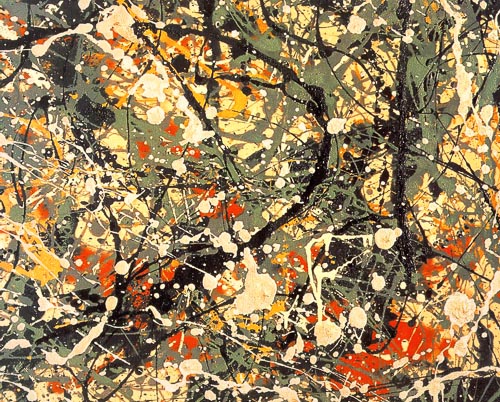
pollock number 8. 1949 oil, enamel jpg

(Pic #2): “Number 8” oil and enamel on canvas by Jackson Pollock

Chaos on Canvas:

In fine art, especially in emotional abstract expressionism, successful disorder is often considered a “happy accident.”

Jackson Pollock embraced this kind of spontaneity in his work. He is best known for the paintings that look more like haphazard splatters than literal representations of everyday life.

One of Pollock’s contemporaries, Willem de Kooning believed that Pollock brought chaos to the world of painting “so that a new painting could be born out of the chaos he created.”

I can’t imagine my southbound trucker had the same intention, but at least I get to showcase his unintentional, anonymous work of art on the worldwide web.

Filed Under: Found Art Tagged With: art on the freeways, chaos in art, found art, Jackson Pollock, organized chaos

“Think Outside The Box” — Who Came Up With This One?

March 6, 2011 by Lonnie Lardner

(Pic #1) "Outside the Box" Furniture Design: by Bauke Knottnerus

The origin of this well-worn phrase dates back to a brain game invented almost a century ago

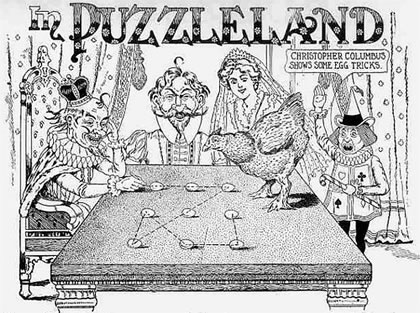
I get asked about this phrase all the time in my corporate wokrshops. The reference, it turns out, is quite literal. The “box” they were talking about was actually a 2-dimensional square made up of nine small dots. (Pic #2) The image appeared in Sam Loyd’s Cyclopedia of 5000 Puzzles, Tricks, and Conundrums in 1914.  Instructions read this way:

(Pic #3) Nearly 100 years old: Sam Loyd's Egg Puzzle

“Draw a continuous line through the center of all the eggs so as to mark them off in the fewest number of strokes.”  Loyd was apparently a little sloppy with the game’s rules and probably should have added that the lines must be straight, although he did supply an illustration that makes the meaning clear. (Pic #3)

(Pic #2) Nine dot puzzle: Click on dots for animated solution.

Simply put: Without letting your pen leave the paper, draw four straight lines through the nine dots. If it’s your first time, you might assume you are bound by an imaginary square or flattened box. But that perception leads nowhere. No matter how many times you try to draw four straight lines without lifting your pen, a dot is always left over.

What if….

This is where creative xenical thinking comes into play. “What would happen if I extend one of these lines beyond the box?” What happens — is the solution. (Click on dots on the left.) There’s even more than one  way to win (Pics #4 & #5).

(Pic #5) Puzzle solution #2

In the 1960s and 70s, business consultants resurrected the old Nine Dot Puzzle as a test for corporate trainees.  The “box” – with its elements of rigidity and squareness –  symbolizes constrained and unimaginative thinking. This is in contrast to the open and unrestricted  “outside the box” or “blue-sky” approach to problem-solving.

(Pic # 4) Puzzle solution #1

Quite often, creativity trainers won’t mention to their groups that they are allowed to extend their lines outside the box. Once they hear they were allowed, the trainees protest that it’s not fair — and typically the presenter will respond by saying, ” I didn’t tell you you couldn’t go outside the box.”

What is this fear?

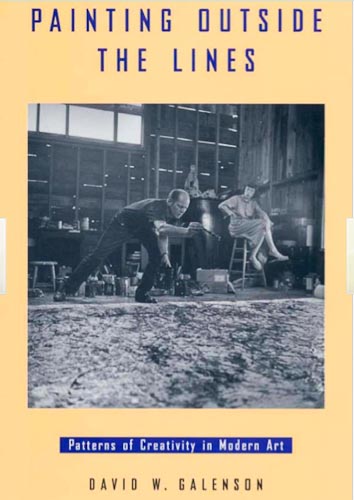
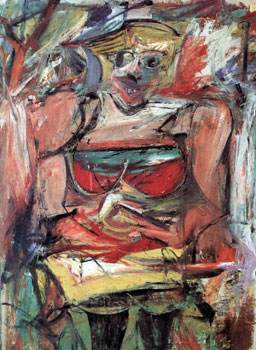
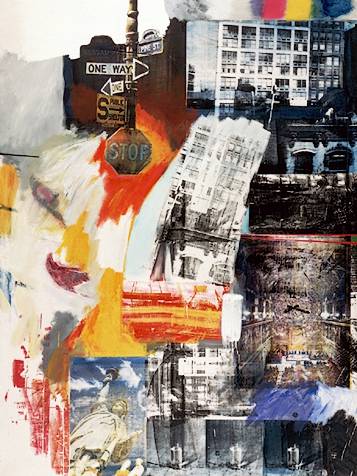
Why wouldn’t we naturally explore the outer limits of this open square? I suspect that it calls up our childhood sense of obedience when we were repeatedly told to color “inside the lines.” When I think of this notion, I am grateful that the little Jackson Pollock, Willem de Kooning, and Robert Rauschenberg had other ideas. 

(Pic #6) de Kooning, "Woman V" 1953

(Pic #7) Robert Rauschenberg (1925-2008)

Filed Under: Creative Zone Tagged With: brain game, brain teaser, coloring inside the lines, corporate catch phrases, corporate creativity, corporate training, creative thinking, egg puzzle, Jackson Pollock, outside the box thinking, painting outside the lines, Robert Rauschenberg, Willem de Kooning

Subscribe here:

Categories

  • Art Table Tips
  • Artist Spotlight
  • Creative Zone
  • Eco-Art
  • Found Art
  • Newsmakers
  • Quotes
  • Reflections
  • Travel
  • Uncategorized

Archives

Hey Brubeck, Take THIS.

The Alien And The Volcano: Why Do Our Brains Need to Make Order Out of Chaos?

Wait — So How Do YOU Choose a restaurant?

Meet Creative Voltage!

Sometimes Your Cat Just Makes The Art FOR You

2026: Kicking Fear to the Curb

Choosing Gratitude. But for a paintbrush?

Every Page Is A Treasure: Discovering Plastikcomb

Calling all artists — INKTOBER is here! Whaaaaa?

Art From The Ashes

One Click — One Masterpiece?

When Art F*cks With Your Head

The Perfect One-Liner

Portland: A Tale Of One City – Through Two Lenses

Happy New Year!

Allowing The Moment To Emerge

How Can A 5-Year-Old Be My Muse?

Stunning, Simple Beauty

An Unexpected Collaboration With Nature

Pathetic Shoe Obsession: WTF?

Copyright © 2026 · Dynamik-Gen on Genesis Framework · WordPress · Log in