The Lardner Report

Unleash your creative superpowers!

  • Home
  • Creative Voltage Website
  • Contact
  • Archives
  • About

Art vs: Science — Which Is More Important?

May 23, 2011 by Lonnie Lardner

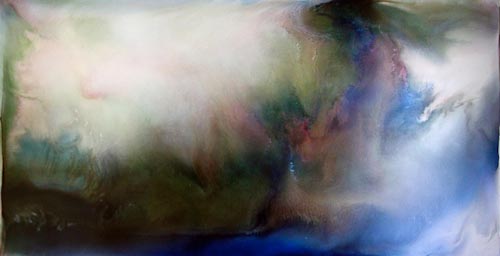
Painting by Suzan Woodruff: Water Lilies' Dream, Acrylic on Panel, 2010

“Science is what allows us to survive, but art makes the survival bearable.”

GUEST POST  by Professor Chris Staley, School of Visual Arts, Penn State University

Which is more important: science or art? Most people would say science. In answering this question I can’t help but think of the word Sputnik, and my grandfather James Killian.  In 1957, when the Soviet Union launched Sputnik, the first man-made satellite, it extended the Cold War into space and altered the trajectory of my life. (Pic #2) At that time my grandfather was the president of the Massachusetts Institute of Technology and shortly after Sputnik was launched he was chosen by President Dwight Eisenhower to be the first full-time scientific adviser to the president. In my mind, my grandfather became “Mr. Sputnik.”
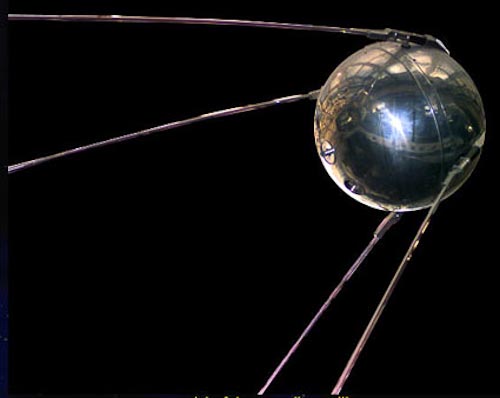
(Pic #2) The Soviet Union launched Sputnik 1 on Oct. 4, 1957 - a beach ball-sized sphere that took about 98 minutes to orbit Earth.

What most people did not know about this leader of science was that he also was an artist. He was an active painter and sculptor. I have vivid memories from my youth of walking around his cluttered studio above the garage and seeing works of art in progress. Equally indelible are comments he made about art’s ability to inspire us all to learn.

When school boards and college administrators are faced with budgetary cutbacks, art classes are often the first to be deemed expendable. However, in these times of accelerating change we need art in our schools more than ever. Why? At its core, art is about asking questions and exploration. More than ever, we live in a world that needs creative solutions to difficult social, political and economic problems.

The essence of art is creativity. If we are afraid of failure and consumed with getting the right answer, it inhibits our ability to explore a wide range of creative options. The search for new ways of seeing and understanding is at the heart of both womans health scientific and artistic discovery.
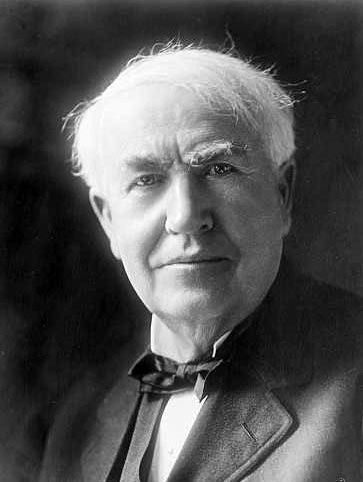
(Pic #3) Inventor Thomas Edison: on genius

It was Thomas Edison who famously said, “Genius is 1 percent inspiration, 99 percent perspiration.”(Pic #3)  In other words, the creative process can save us from the poverty of our intentions. This willingness to simply try things for the sake of trying things is a leap of faith. It is the belief that play and chance have inherent value that can lead us to great discoveries.
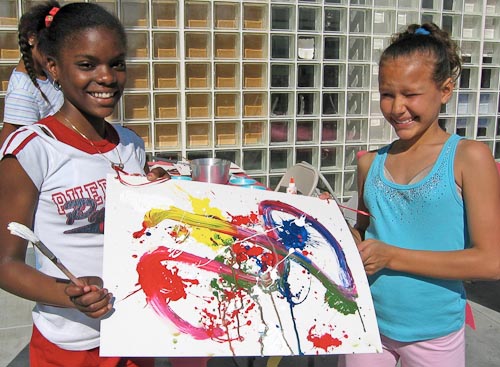
Young artists participating art workshops in South Central Los Angeles.

Increasingly our educational system is based on a means to an end. It’s an environment geared toward memorization and test results, not creative, explorative learning. We have lost sight of the fact that we learn not just with our minds, but also with our hearts. Once my 9-year-old daughter Tori asked me, “Dad who is more creative, children or adults?” I said, “I don’t know. Who do you think?” She said, “I think children are because we have more time.”

Her poignant insight confirms what we know — that slow time can allow for meaningful moments of reflection. Yet in a society that emphasizes efficiency and production, the notion that play and time to reflect are an integral part of learning can easily be dismissed.

In his book “The Education of a College President,” my grandfather wrote, “In a very deep sense art and science are interdependent, and they spring from the same act of imagination.” During difficult economic times, fear and anger can negatively influence our decisions to move forward in a positive direction. In contrast, art can inspire our imaginations to move beyond our fears, to a more promising way to live.

We need the foresight and courage to create classrooms where exploration and play are encouraged. We need to remember that questions are just as important as answers.

Editorial courtesy of the author and Centre Daily News.  First published May 9th, 2011
 

Filed Under: Creative Zone Tagged With: art education, Chris Staley, creative stimulation, creativity, imagination, ingenuity, inspiration, James Killian, science vs: art, scientists, Sputnik, Thomas Edison, value of art in science

Graffiti — Art, Crime, or Both?

May 11, 2011 by Lonnie Lardner

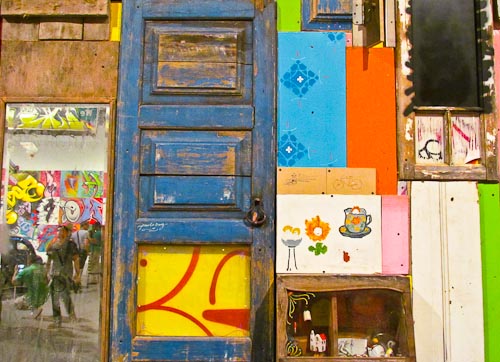
(Pic #1) Stunning wall of distressed doors and windows from Brazil — “Art In The Streets” – MOCA

New exhibit demands our attention.

The debate is raging in Los Angeles right now, where the Geffen Contemporary at the Museum of Contemporay Art has launched a comprehensive, controversial exhibition called “Art In The Streets,” which will remain open through August 8th. That should give you plenty of time to judge for yourself on how the exhibit – showcasing 50 world-famous graffiti artists’ life work – should be defined, or positioned in art history. Check out this small sampling, and  then get downtown.

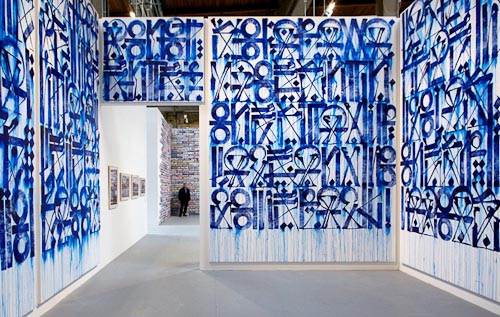
Calligraphic installation by “Retna” named after a Wu-Tang Clan song (aka Los Angeles-based artist Marquis Lewis)

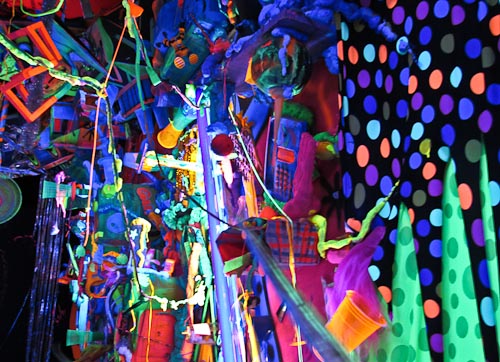
"Cosmic Cavern" neon installation by Kenny Scharf

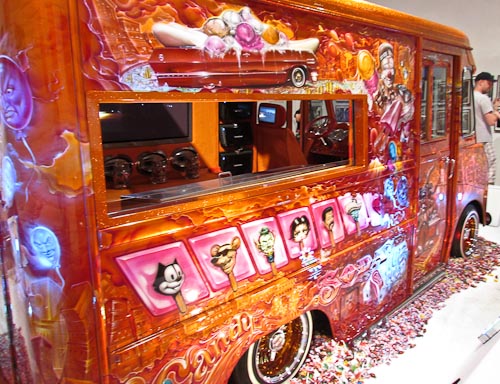
Mister Cartoon's "International Ice Cream Truck" 2010

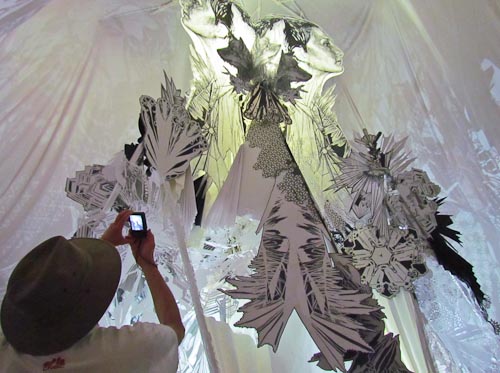
Paper installation by "Swoon"

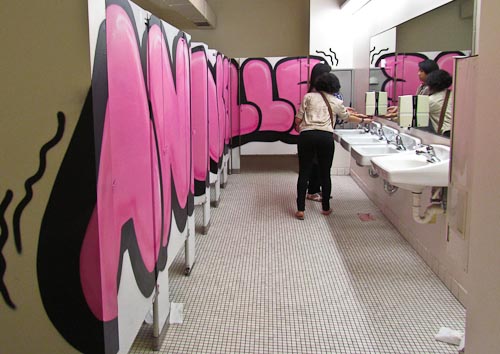
Street art by "Andre" extends into Geffen Ladies' Room. "Anabelle" said to be his GF.

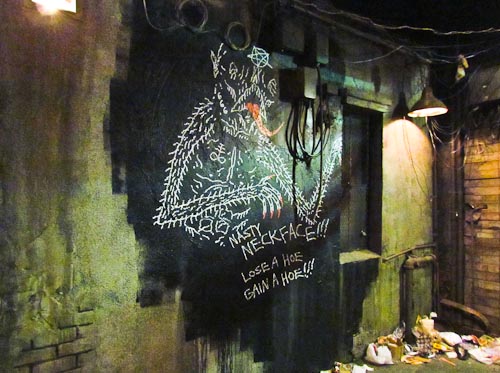
Installation in a dark corner by "Neckface" considered "the scariest" in the exhibition.

Henry Chalfont documents subway car art -- "a way to overcome our faceless anonymity."

Painting by Dondi White - "Born Again" (1986)

Los Angeles street art pioneer Chaz Bojorquez

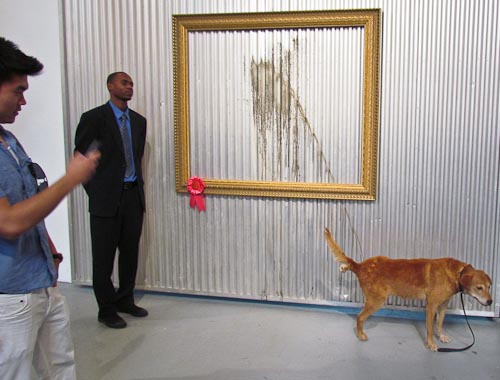
"Pissing dog" installation by Banksy

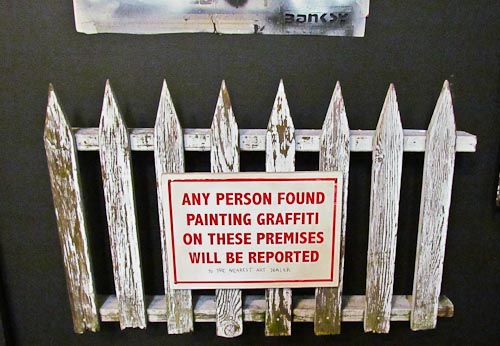
Banksy wall sculpture - fine print on bottom says: "...to the nearest art dealer."

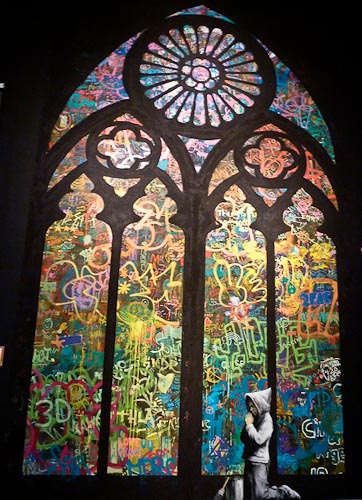
Banksy enlisted the help of 8th and 9th graders at City of Angels School for his floor-to-ceiling "Stained Glass Window."

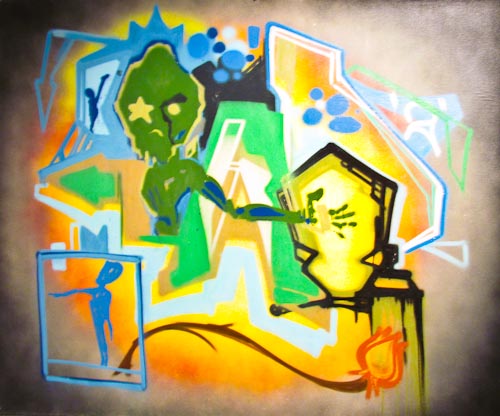
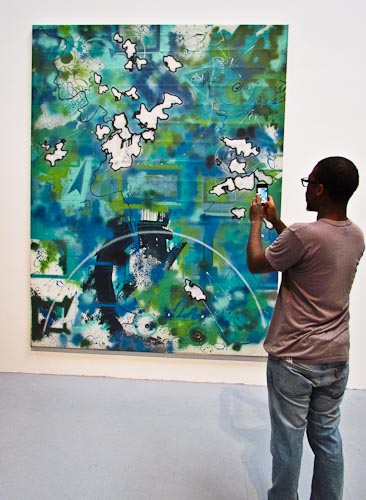
Vibrant abstraction by "Futura" (Leonard McGurr)

An authentic urban voice

Personally, I find this kind of raw visual ambien expression packed with high energy and substance.  It reminds me that so much great art comes from unexpected places. Our culture would never be as diverse or as rich if it were not for the countless new voices from the inner city — showcasing themselves through rap, poetry and dance.  MOCA’s street art show, much like rap, allows for those authentic voices to be heard in a public forum.

However — Saying the MOCA show “glorifies graffiti,” the L.A.P.D. and L.A. County Sheriff’s Department both report that instances of vandalism are up in the surrounding area, Little Tokyo.

But MOCA Director, Jeffrey Deitch says the LAPD is overreacting and that the “anarchy” displayed by the street art subculture was to be expected. He also reminds street art critics that MOCA is cleaning up after the renegade artists.

Censorship or Sensitivity?

In the meantime, Deitch has done some “cleaning up” of his own. The former NY art dealer ordered a $13,000 museum-commissioned mural by Italian street artist “Blu” white-washed off the side of his own building.

A brief appearance: Anti-war mural by Blu, white-washed by MOCA

The anti-war image (seen at right) pictures a line of coffins covered in dollar bills. Critics call the white-wash “censorship.” Deitch calls it being sensitive to the neighborhood, home to a Veterans’ hospital and a war memorial to Japanese-American soldiers. The work, therefore, was considered “inappropriate.” And it’s gone.

The irony is obvious. As the L.A.Times points out—Street art is inherently “fugitive by nature, and vulnerable to being destroyed by angry shopkeepers who just don’t appreciate the creativity.” But here, the same museum that commissioned the radical work — also wiped it out. Apparently, Deitch had not asked to see a sketch.

Now that’s art.


Filed Under: Newsmakers Tagged With: Banksy, Chaz Bojorquez, Dondi White, Futura, Geffen Contemporary, graffiti art, graffiti controversy, Henry Chalfont, international ice cream truck, Kenny Scharf, Mister Cartoon, MOCA, Neckface, Retna, street art, Swoon, vandalism, whitewashing ar

“Barbie Cam” – Big Hit On Campus

April 30, 2011 by Lonnie Lardner

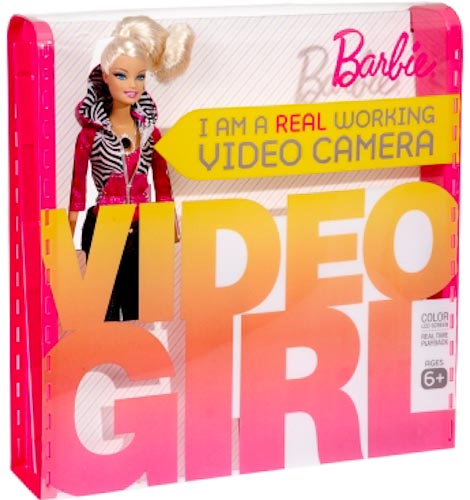
(Pic #1) Capture what Barbie sees — with “Video Girl”

Mattel’s new “Video Girl”  enthusiastically embraced by UCLA Film School –  in its first annual Barbie Film Festival

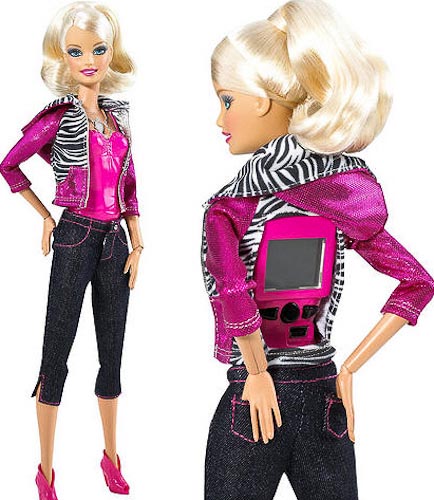
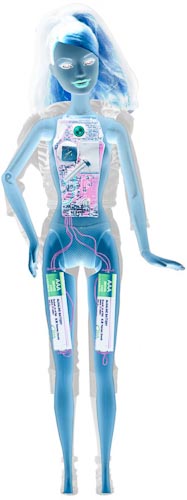
(Pic #2) “X-ray” Barbie — inside a pop icon. TSA, eat your heart out.

This is a story about a great marketing idea and the completely unexpected ways it can go viral.  More on that in a moment, but first a little background:

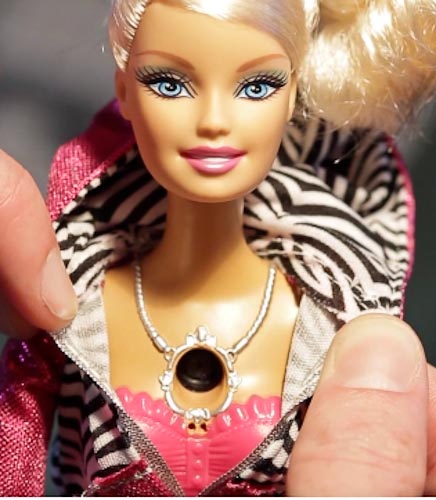
Mattel recently launched the new “Barbie Video Girl” doll targeted for girls ages 6 – 10. A toy designed for girls to tell stories through Barbie’s eyes  — uh, rather, chest. At least that’s where you’ll find the miniature lens and all the necessary recording tools in the iconic bombshell.

Check out Barbie’s “specs”  to the left.  Mattel designers cleverly conceal a digital camera inside  her necklace — and an LCD video screen on her back (above) that allows a little moviemaker to record and view movies instantly. The doll includes a USB plug-in cord, and is Windows-and Mac-compatible. Her batteries are built into her sleek supermodel thighs.

(Pic #3) Video Girl’s “necklace cam”

According to the Director of Marketing for Barbie, Rosie O’Neill, the idea emerged out of a brainstorm session where Mattel’s most creative minds “mashed two ideas together” — just because. They had also noticed on YouTube, that there were countless examples of “Barbie at play” videos, and Mattel needed to ask “how can we enhance their storytelling?” The company’s Product Design and Engineering teams made it happen. “Video Girl” was born. Bottom line, says O’Neill — “Video Girl is a fun tool to inspire girls to become filmmakers.”

Apparently the plan worked. Girls as young as 6 are entering their own short films in a Barbie video contest on line, and learning to edit their films on downloadable Barbie software.

Here’s where the unexpected part comes in.  Amused by the new product, a visual artist named Brandon Bloch posts on YouTube a tongue-in-cheek review, comparing  the high-end Canon 7D digital SLR (retail price $1800.00) with the high-concept Barbie Cam (retail price $50.00).  That caught the eye of UCLA Professor/cinematographer Tom Denove,  who also vice chairs the Department of Film, TV, and Digital Media at the school. His reaction was simple “Let’s get Barbie Cams for our students and staff.”

Next stop: Toys R Us.

Tom bolted buy ambien online over to the nearest toy store to evaluate the merchandise. Would the camera really work? Could his students make decent short films with a Barbie Doll? He began to “inspect” the doll’s parts in the store, and had to field questions from onlookers. “It was weird” said DeNove — “I had to shout back — It’s okay, I’m a cameraman!” He tested  the camera, and it worked. While he said the resolution wasn’t great, it would be an important lesson for his young directors to learn — “It’s not about the equipment. It’s what you do with the story.” He then called Mattel to see if the the company would sponsor his idea for a Barbie  Film Festival.  Mattel jumped on board — and agreed there would be no censoring of content.

The task was simple: Students had one week to produce and direct their 2-minute films on any subject they wanted — but they had to be shot with a Barbie cam. Typically, with a fast assignment like this, “they stress out.” But with “Video Girl,” he said, “they were totally into it.” The affable prof said he sensed that the task “brought out the kid in all of them.”

The films covered all the genres…horror, comedy, animation, and “Barbie Noir.”

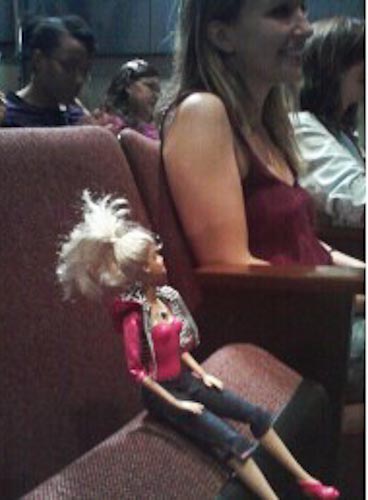
(Pic #4) Spotted!

I saw all 31 entries. They were refreshingly good. I never know what awaits me in the theater –especially when the event is billed as “The First Annual” anything. But Barbie pulled through.  Doesn’t she look proud sitting in the seat  across from me? (Pic #4). To her left there, is Scottie Bookman, who directed her in a short called  “A Barbie For All Of Us” — which won the festival’s “Barbie Bruin Spirit Award” that night.

Check out the festival’s Best Comedy — “Audition For Barbie” —  directed by MFA Director/Cinematographer Judy Phu.  It’s a slice of everyday Hollywood casting, where this time, the auditioning actor (Justin Wescoat Sanders) is asked to play a scene opposite an actress who comes off  — “a little plastic.”

Click here to view clips from the UCLA Barbie Film Festival shorts.

This just in: Mattel Inc. reported its quarterly global sales of Barbie products UP 14 %.  This is the first time the Barbie brand has had double-digit sales growth in the first quarter since 1997.


Filed Under: Newsmakers Tagged With: Barbie, Barbie cams, Barbie Film Festival, genius marketing, hidden camera, Mattel, UCLA film school, Video Girl

  • « Go to Previous Page
  • Page 1
  • Interim pages omitted …
  • Page 69
  • Page 70
  • Page 71
  • Page 72
  • Page 73
  • Interim pages omitted …
  • Page 85
  • Go to Next Page »

Subscribe here:

Categories

  • Art Table Tips
  • Artist Spotlight
  • Creative Zone
  • Eco-Art
  • Found Art
  • Newsmakers
  • Quotes
  • Reflections
  • Travel
  • Uncategorized

Archives

09/27/2026 Los Feliz Wild Art Junk filled truck

Art? Or, Reflection Of My Mental Instability…

Hey Brubeck, Take THIS.

The Alien And The Volcano: Why Do Our Brains Need to Make Order Out of Chaos?

Wait — So How Do YOU Choose a restaurant?

Meet Creative Voltage!

Sometimes Your Cat Just Makes The Art FOR You

2026: Kicking Fear to the Curb

Choosing Gratitude. But for a paintbrush?

Every Page Is A Treasure: Discovering Plastikcomb

Calling all artists — INKTOBER is here! Whaaaaa?

Art From The Ashes

One Click — One Masterpiece?

When Art F*cks With Your Head

The Perfect One-Liner

Portland: A Tale Of One City – Through Two Lenses

Happy New Year!

Allowing The Moment To Emerge

How Can A 5-Year-Old Be My Muse?

Stunning, Simple Beauty

An Unexpected Collaboration With Nature

Copyright © 2026 · Dynamik-Gen on Genesis Framework · WordPress · Log in