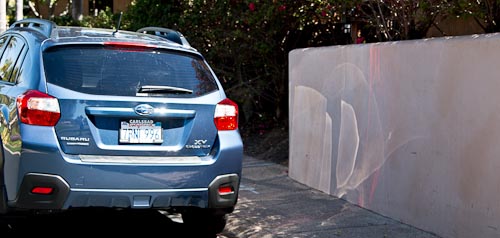
See – this incredible collection of shapes and colors was caused by the San Diego sun reflecting off the tail and brake lights of a Subaru XV that was parked near the entrance to the hotel. (Pic #5) It was there just long enough for me to notice it, and grab a quick picture. It will never hang in a museum, or gallery for that matter, nor the dining room of a ritzy resort, but for one moment, on one Sunday morning, it emerged as a masterpiece.
Who Says It’s Art? You Do

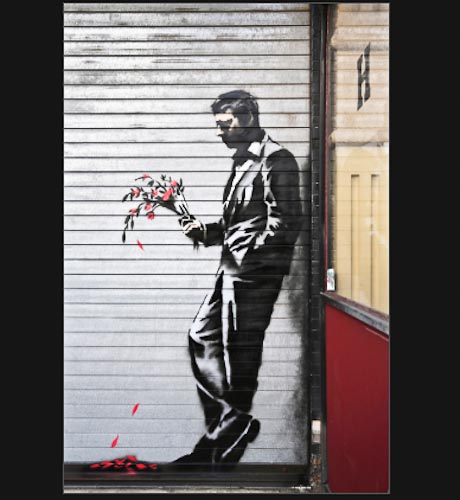
(Pic #1) Banksy street art ambushed onto the security door to Larry Flynt’s Hustler Club in Hell’s Kitchen, NYC. (2013)
Guest post by Josh Kaplan
I often ask Lonnie (to her unending annoyance) why a Jackson Pollock canvas can sell for millions of dollars, while a piece she did to show some students the method Pollack used, is worth nothing. I point out, the two paintings look pretty much the same. She always explains, that Pollack created a new dimension to modern art, a new genre, something that had never been done before, and therefore had an intrinsic value that copycat work could never match.
It’s a reasoned argument. It makes perfect sense, but to me it has a degree of mysticism attached to it, if not a degree of hogwash. Which is why I noted with glee the experience that some New Yorkers had over the past month. The infamous graffiti artist Bansky, trying to prove whatever latest point he was trying to prove, set up a stand in Central Park selling some of his original works. He also arranged for a cameraman to record the whole thing.
For those of you who follow art, you know that Banksy’s work fetches hundreds of thousands of dollars. Each. He had his representative sitting there with 40 originals ambien comparison priced at 60 bucks apiece. They looked like Banksys, the sign guaranteed they were original Banksys, but at the end of a long day, the poor guy sitting there had sold 7 pieces. Total. $420 bucks.
Once the story got out, and all those New Yorkers realized they had blown their chance to make a financial killing, there was the expected hand wringing. So no big surprise that a week later, three artists opened up a booth selling admittedly bogus Banksys. Fakes. Replicas of the 40 originals that no one wanted the week before. Each painting even came with a “Certificate of Inauthenticity.” They sold out. Fast. The artists said they did it to complete Banksy’s point about the nature of hype and art.
So what is the moral of the story? There really isn’t one, except perhaps this. As I have seen with Lonnie over and over again, anyone involved in an artistic venture faces a powerful temptation to allow a critic, or potential buyer determine for you the worth of your creation. That is often a heartbreaking proposition. It’s hard not to take it personally, but the next time it happens to you, try to remember, you are selling an original masterpiece, but your audience may have their heart set on a cheap imitation.
Today’s Pic: NYC Curbside Masterpiece
Sometimes the break-neck pace of urban life thrusts me into obsessive focus-on-the-task mode. Head down. Beat the crowd. Find a seat on the subway. Fight the dude hailing your cab. Make the 7:20 for Garden City. And, along the way – find a restroom that doesn’t completely gross you out.
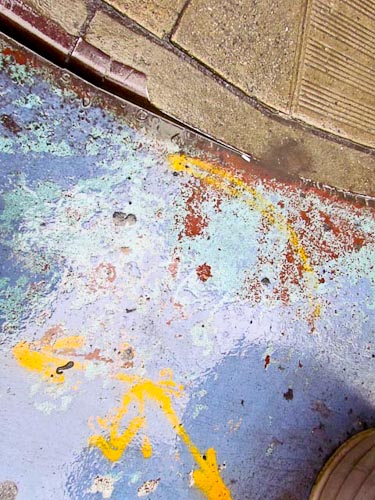
Then, there are days like this one, in the pouring rain, dark sky, no umbrella, no boots, and heading for a really bad hair day — I look down and see a happy little painting on the sidewalk outside the Morgan Stanley building at 47th and Broadway. I have no idea how all those colors landed on the street. But I loved the combination, and especially adderal appreciated the yellow “accents” spray-painted by someone I surmised worked for the city water dept.
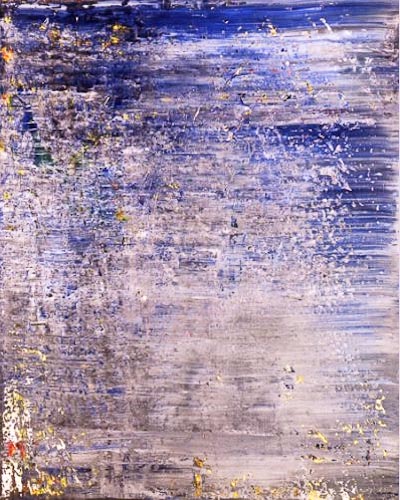
No one seemed to notice – but it stopped me in my tracks. I grabbed a shot in the downpour. The periwinkles, lilacs, and blues let me know all was right with the world. Oddly, the “accidental” art reminded me of the work of master German abstract painter Gerhard Richter (Pic #2, left) — an artist who works and re-works his canvas until it resembles nothing like his starting point.
I am reminded that art can also happen in an instant — it’s there for the viewing — if only we allow it to emerge.