The Lardner Report

Unleash your creative superpowers!

  • Home
  • Creative Voltage Website
  • Contact
  • Archives
  • About

Tripping Over Art

May 31, 2011 by Lonnie Lardner

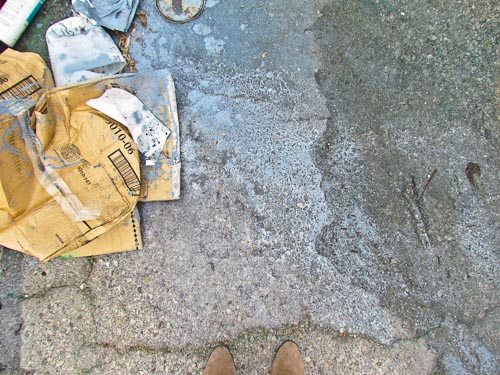
(Pic #1) The confluence of trash and chemistry make a perfect photo opp

Truly savoring those split-second encounters with beauty, oddity and unexpected inspiration

Working on a public art project in a maintenance yard in West Los Angeles recently, I bent over to retrieve my pen and caught a glimpse of scattered trash, smashed cans, spilled chemicals, and some sort of baby blue iridescent powder spewed out on the cracked cement (Pic #1). It reminded me of the kinds of abstract paintings and collages I’m drawn to, and it made me wish I’d assembled this one first.

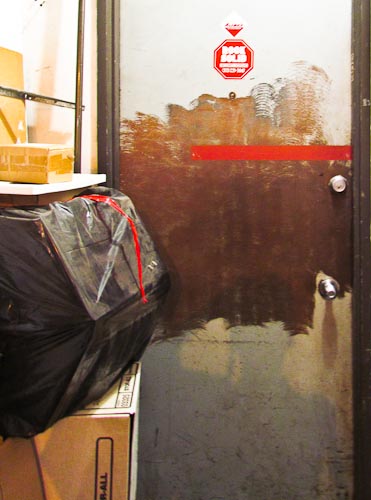
(Pic #2) Wrong turn - right art

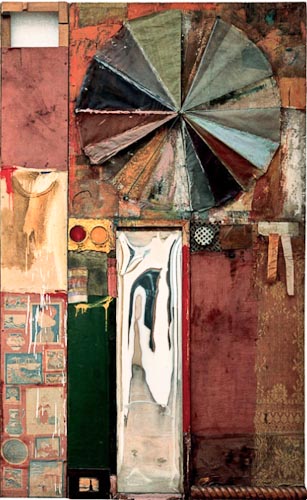
A week later, in downtown Los Angeles at the old historic Pabst Brewery, I took a wrong turn during an art exhibition and found myself  in a hallway not included in the ArtWalk map. Again, a pile of junk — this time stacked up against a rusted door sporting a straight red line dividing the space into thirds (Pic #2).  To me, it had all the appeal of my first cholesterol lowering encounter with a Rauschenberg assemblage (Pic #3). The jolt comes in the discovery. The joy comes in documenting the image and taking it home.

(Pic #3) "Charlene" assemblage by Robert Rauschenberg, 1954

The lesson?

Imagine how many visual treats you might discover if you really began to look. Every time you step off a curb, drive through a car wash, or stand at the post office, you’d be adding to your mental – or digital- archive. Whether it’s on the back of a truck or trash on the street, the right combination of “things” is always vying for our attention. But unless we actually take advantage of the opportunity, the chance to capture these lovely images passes us by.

Art can truly be found everywhere…. even in your neighbor’s swimming pool. See “pool art” here. I promise you, by allowing yourself to spot it, catch it, and record it, you get to ignite your creative instincts, and more important, enrich your work – and your life.


Filed Under: Found Art Tagged With: discovering your creative side, Finding art everywhere, inspiration, on on the street, Rauschenberg assemblage, right brain, stimulating creativity

Red Sticker Project: Be “Critic For A Day”

May 29, 2011 by Lonnie Lardner

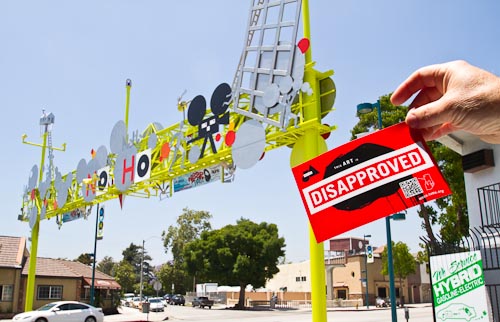
(Pic #1) North Hollywood Arts District landmark sculpture, “NOHO Gateway” by Peter Shire — gets “DISAPPROVED” — by anonymous

Angelenos judge art on the streets

When something gets “red-tagged” in Southern California, it usually means someone’s house  is about to fall off a cliff after a sizable earthquake. I should know, I had that happen in the 6.9 Northridge quake of 1994.  The city inspectors literally tag your door with a foreboding hanging red card, warning homeowners to enter  “at their own risk.”

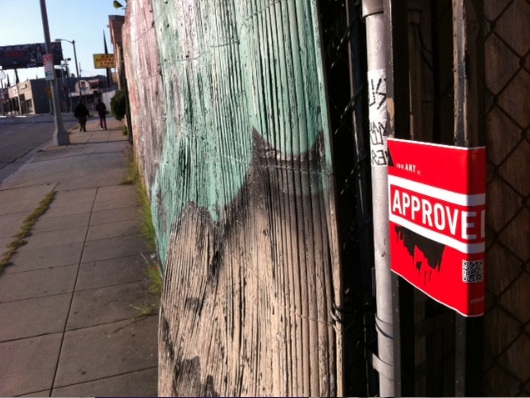
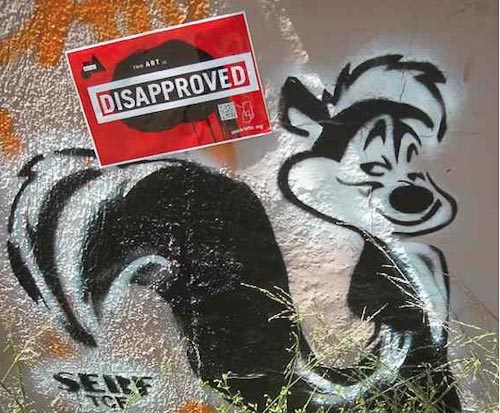
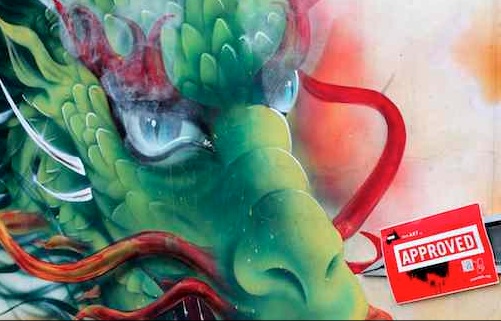
Well now, the act of “red tagging” takes on new meaning. It’s an opportunity for Angelenos to give an immediate visual thumbs-up or thumbs-down on the art they see on the street – work that is planned or unplanned.  A privately-supported group of art watchers called MOCA-Latte has launched a site where you can order stickers (for free). You are asked to participate in their quest by affixing the labels onto the work you love or hate. Take a picture, then upload to their site.

How it all started…

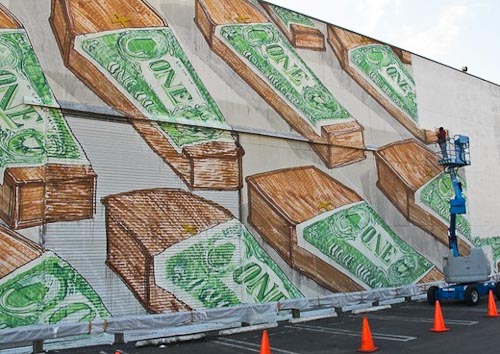
(Pic #2) Whitewashed anti-war mural (before destruction) by street artist “Blu”

The reactionary movement started when the director of the Museum of Contemporary Art (MOCA), Jeffrey Deitch, whitewashed a mural he commissioned on the exterior of the MOCA building from Blu, a prominent Italian street artist. The image showed  military-style coffins draped with dollar bills instead of American flags (Pic #2). It was to coincide with the opening of the groundbreaking MOCA exhibit on graffiti art called “Art in the Streets.”

Critics called the white-wash “censorship.” Deitch called it being sensitive to the neighborhood — home to a Veterans’ hospital and a war memorial to Japanese-American soldiers.

(Pic #3) “Ayatollah Deitch” response painting by “Anonymous”

In response to his act, an anonymous street artist put up a wheatpasted mural near MOCA that depicted Deitch as the Ayatollah Khomeini, dressed in traditional garb, holding a dripping paint roller  – fresh from removing Blu’s mural from the museum’s wall.

Deitch’s action inspired robust debates on what should be called art and what museums’ roles should be in showcasing controversial work.  According to the mastermind of the red sticker campaign, Nick Douglas, “It’s exciting to see this level of discussion about art in Los Angeles – a pretty rare occurrence in this city.”

APPROVED or DISAPPROVED –“Stick it.”

Now, Los Angeles art watchers have taken to the streets to document their affection for or outrage about the art they see every day. Armed with stickers in hand they’ve begun to express their points of view on work found in back alleys and on exclusive oceanfront property. Some critics have even taken their mission to social media platforms… i.e., “The Gateway” public art project in NOHO (Pic #1) has earned its own “Tear Down the Gateway” page on Facebook. Below, a few more samples of the musings of L.A.’s ad hoc critics.

Whatever you think about the judgements slapped on these works–at least we’re talking.

(Pic #4) “Ape Boy” on LaBrea and 8th “DISAPPROVED”

An anonymous tagger says of the graffitied face above:  “DISAPPROVED — some sort of anime ape boy face wheat-pasted to a switching box. Yawn.”

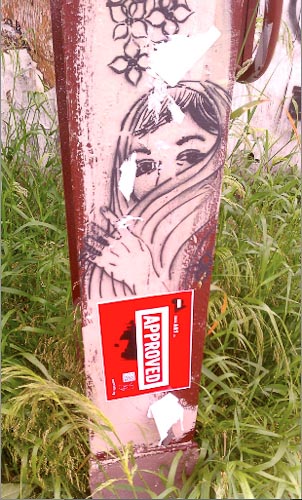
(Pic # 5) “Veiled girl” – Echo Park – “APPROVED”

(Pic #6) Butterfly girl on Channel Drive beachfront wall in Santa Barbara — “APPROVED”

(Pic #7) “Eat the Rich” – “APPROVED”

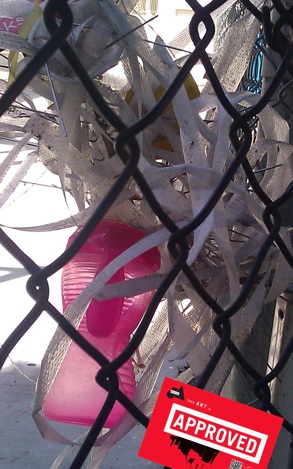
(Pic #8) Chain link installation – “APPROVED”

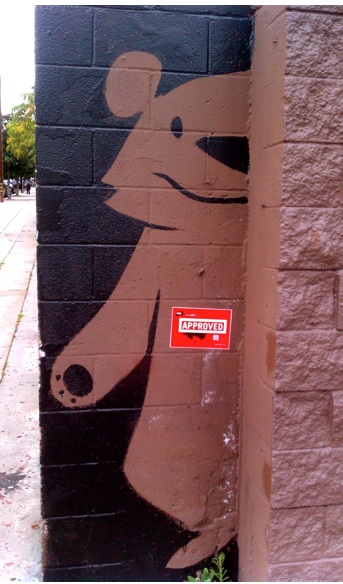
(Pic #9) Echo Park Brown Bear – “APPROVED”

(Pic #10) Mr. Brainwash (detail) – “DISAPPROVED”

(Pic #11) Green Fence – “APPROVED”

(Pic #12) Pepe Le Pew – “DISAPPROVED”

(Pic #13) Echo Park trash – “DISAPPROVED”

(Pic #14) 76 Station mural – 800 No. Western – “APPROVED”

Cool related  links: click here.


Filed Under: Newsmakers Tagged With: art critic for a day, art critics, artist Blu, graffiti art, graffiti controversy, Jeffrey Deitch, L.A art, MOCA, MOCA-latte, NOHO gateway, red sticker campaign, street art controversy

Art vs: Science — Which Is More Important?

May 23, 2011 by Lonnie Lardner

Painting by Suzan Woodruff: Water Lilies' Dream, Acrylic on Panel, 2010

“Science is what allows us to survive, but art makes the survival bearable.”

GUEST POST  by Professor Chris Staley, School of Visual Arts, Penn State University

Which is more important: science or art? Most people would say science. In answering this question I can’t help but think of the word Sputnik, and my grandfather James Killian.  In 1957, when the Soviet Union launched Sputnik, the first man-made satellite, it extended the Cold War into space and altered the trajectory of my life. (Pic #2) At that time my grandfather was the president of the Massachusetts Institute of Technology and shortly after Sputnik was launched he was chosen by President Dwight Eisenhower to be the first full-time scientific adviser to the president. In my mind, my grandfather became “Mr. Sputnik.”

(Pic #2) The Soviet Union launched Sputnik 1 on Oct. 4, 1957 - a beach ball-sized sphere that took about 98 minutes to orbit Earth.

What most people did not know about this leader of science was that he also was an artist. He was an active painter and sculptor. I have vivid memories from my youth of walking around his cluttered studio above the garage and seeing works of art in progress. Equally indelible are comments he made about art’s ability to inspire us all to learn.

When school boards and college administrators are faced with budgetary cutbacks, art classes are often the first to be deemed expendable. However, in these times of accelerating change we need art in our schools more than ever. Why? At its core, art is about asking questions and exploration. More than ever, we live in a world that needs creative solutions to difficult social, political and economic problems.

The essence of art is creativity. If we are afraid of failure and consumed with getting the right answer, it inhibits our ability to explore a wide range of creative options. The search for new ways of seeing and understanding is at the heart of both womans health scientific and artistic discovery.

(Pic #3) Inventor Thomas Edison: on genius

It was Thomas Edison who famously said, “Genius is 1 percent inspiration, 99 percent perspiration.”(Pic #3)  In other words, the creative process can save us from the poverty of our intentions. This willingness to simply try things for the sake of trying things is a leap of faith. It is the belief that play and chance have inherent value that can lead us to great discoveries.

Young artists participating art workshops in South Central Los Angeles.

Increasingly our educational system is based on a means to an end. It’s an environment geared toward memorization and test results, not creative, explorative learning. We have lost sight of the fact that we learn not just with our minds, but also with our hearts. Once my 9-year-old daughter Tori asked me, “Dad who is more creative, children or adults?” I said, “I don’t know. Who do you think?” She said, “I think children are because we have more time.”

Her poignant insight confirms what we know — that slow time can allow for meaningful moments of reflection. Yet in a society that emphasizes efficiency and production, the notion that play and time to reflect are an integral part of learning can easily be dismissed.

In his book “The Education of a College President,” my grandfather wrote, “In a very deep sense art and science are interdependent, and they spring from the same act of imagination.” During difficult economic times, fear and anger can negatively influence our decisions to move forward in a positive direction. In contrast, art can inspire our imaginations to move beyond our fears, to a more promising way to live.

We need the foresight and courage to create classrooms where exploration and play are encouraged. We need to remember that questions are just as important as answers.

Editorial courtesy of the author and Centre Daily News.  First published May 9th, 2011


Filed Under: Creative Zone Tagged With: art education, Chris Staley, creative stimulation, creativity, imagination, ingenuity, inspiration, James Killian, science vs: art, scientists, Sputnik, Thomas Edison, value of art in science

  • « Go to Previous Page
  • Page 1
  • Interim pages omitted …
  • Page 68
  • Page 69
  • Page 70
  • Page 71
  • Page 72
  • Interim pages omitted …
  • Page 85
  • Go to Next Page »

Subscribe here:

Categories

  • Art Table Tips
  • Artist Spotlight
  • Creative Zone
  • Eco-Art
  • Found Art
  • Newsmakers
  • Quotes
  • Reflections
  • Travel
  • Uncategorized

Archives

Hey Brubeck, Take THIS.

The Alien And The Volcano: Why Do Our Brains Need to Make Order Out of Chaos?

Wait — So How Do YOU Choose a restaurant?

Meet Creative Voltage!

Sometimes Your Cat Just Makes The Art FOR You

2026: Kicking Fear to the Curb

Choosing Gratitude. But for a paintbrush?

Every Page Is A Treasure: Discovering Plastikcomb

Calling all artists — INKTOBER is here! Whaaaaa?

Art From The Ashes

One Click — One Masterpiece?

When Art F*cks With Your Head

The Perfect One-Liner

Portland: A Tale Of One City – Through Two Lenses

Happy New Year!

Allowing The Moment To Emerge

How Can A 5-Year-Old Be My Muse?

Stunning, Simple Beauty

An Unexpected Collaboration With Nature

Pathetic Shoe Obsession: WTF?

Copyright © 2026 · Dynamik-Gen on Genesis Framework · WordPress · Log in