The Lardner Report

Unleash your creative superpowers!

  • Home
  • Creative Voltage Website
  • Contact
  • Archives
  • About

The Art of Letting Go

March 30, 2012 by Lonnie Lardner

It is with heavy heart that I share the news that the delicate nest lovingly built by our rufous hummingbird mother (photographed in the previous post) fell victim to a fairly wild winter storm 4 days ago. Nothing remains of her artful home after a two-week vigil over her tiny eggs.

I know it’s nature. I understand that it’s the cycle of life. But it still hurts to watch her work so devotedly, so tirelessly, with no return on her investment.  Still, the pure joy she brought me – and our home – seems immeasurable. Just by being there every day (only flying out occasionally to nourish her petite 3-inch frame) gave us a daily sense of wonder and appreciation. I must have checked on her and the nest 15 times a day, valium through the little peephole in our front door. She was the first task in the morning, and my last stop at night.

Then, when I opened the door to find her home ravaged by the wind, I felt as though I had been hit in the gut. It has taken a few days to emerge from my funk, but I take comfort in knowing some hummingbirds live anywhere from 3 – 10 years. So there’s always a chance she’ll be back.

In her honor, I post this inspiring nature video of another (successful) hummingbird nest with two siblings coming to life — and taking flight for the first time. I could take a cue from their mother — and learn how to gracefully let go.


Filed Under: Newsmakers Tagged With: baby birds fly for the first time, bird nests, hummingbirds, mother feeds young

The Art Of The Nest

March 22, 2012 by Lonnie Lardner

Nature's tiniest artist: Mother hummer prepares her nest with "found objects." Photo by Josh Kaplan.

Hummingbird Mom builds a functional home — and a stunning work of art.

She’s sitting in her flawlessly-crafted nest this very moment. Mother hummer has chosen the bougainvillea vine on our front patio as her maternity ward. We’ve decided to enter our house through the back door now because we don’t want to disturb her. After all, the gestation period for hummingbird babies is just 18 days. Last year she flew in (most likely from Mexico) to lay and incubate her two pea-sized eggs — but she unexpectedly left — without seeing her young break through. She’s back, and we want to make her stay as comfortable as possible.

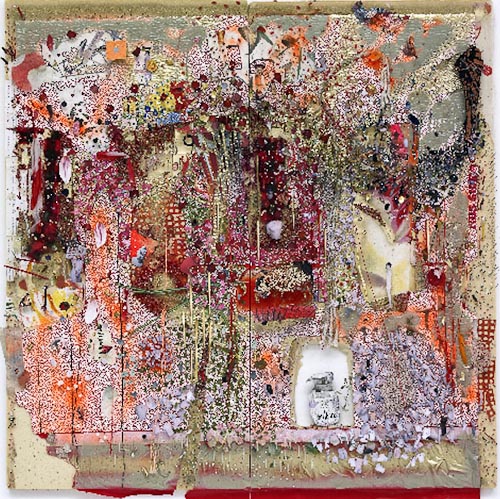
The factoids on these magnificent creatures (listed below) may be sobering, impressive, and just hard to believe — but to me, the real story is the art and architecture emerging out of a bird that weighs less than a penny. I cannot stop examining the structure and beauty of this inch-and-a-half wide thriving little cup of nature. Our spotted “rufous” hummingbird has gathered the most delicate of leaves, dainty flower petals, and flexible twigs. She has camouflaged them with bits of lichen, and spun and glued the “found objects” together with borrowed spider webs. She has created one of the most intricate, and interesting functional collages I’ve ever seen. (Except maybe those of artist Elliot Hundley, Pic #2.)

Much like the work of contemporary “fiber artists” (Pic #3) Mother has sculpted a sort of free-form design with her organic materials, with the added benefit of a solid foundation on which she can raise her family.

Ten days to go. I’m a wreck.

(Pic #2) Assemblage of accumulated bits of lo-fi media, i.e., string, paper, photos and beading. By artist Elliot Hundley.

Pic #3 (Left): "Moth study" by fiber artist Erin Riche. (Right): Detail of crochet art by Margaret Hubert.

Just the Facts:

  • A hummingbird’s heart beats up to 1,260 times per minute.
  • While diving, her wings will beat up to 200 times per second.
  • She will take about 250 breaths per minute –while at rest.
  • They are the only birds who can fly forward and backward.
  • Some hummingbirds will travel over 2000 miles twice a year.
  • To extract nectar, she will visit an average of 1,000 flowers per day.
  • When hummingbirds sleep at night, they go into a hibernation-like state called torpor.
  • A hummingbird’s favorite color is red.


Filed Under: Found Art Tagged With: Ann Maki, art in nature, bird nests, collage, Elliot Hundley, fiber art, found object art, hummingbird facts, hummingbirds, Margaret Hubert, nature's artist, organic sculpture

Through The Artist’s Eye

February 29, 2012 by Lonnie Lardner

What they see is not what we get.

(Pic #1) Left: Scene that inspired David Hockney painting on right.

(Pic #2) (Left) Collage from a commercial catalogue of utensils - source for shapes in painting on right (Joan Miro)

(Pic #3) (Left) Mont Sainte-Victoire, today - source for numerous oil paintings by Paul Cezanne (right).

A lesson from Hockney, Miro, and Cezanne:

Artists show us fresh ways to see familiar things. They’re able to look at something – in nature, on the street, or in life – and interpret the scene or situation in their own very personal way.

To an artist – just about everything is interesting. And as the rest of us expose ourselves to new works of art – radical statements, or unique ideas — our own sense of  “what works” grows stronger.

On this page, we see how contemporary British painter David Hockney (Pic #1, right) takes a serene country scene and creates a colorful palette of pinks, tangerines and lilacs celexa that aren’t even present in the original photo – just one way an artist makes something his own.

Spanish painter/sculptor Joan Miro (Pic #2, right) extracts very specific shapes from his source material – cutout photos of metal utensils and medical instruments – and interprets them in quirky ways on canvas. It’s almost as if his new shapes – with their added detail and spiky lines — have developed a perky personality.

(Pc #4) Paul Cezanne on site - Mont Sainte-Victoire, 1906

Finally, French impressionist Paul Cezanne (Pic #3) became obsessed with interpreting one particular landscape in the South of France – the iconic Mont Sainte-Victoire – and painted it over 60 times. Each painting gives us something new – a different angle, an altered point-of-view, varied textures, or dramatically different hues. It’s something an artist can’t fight – and in fact, truly defines who he is. It’s also why artists are first to observe and reflect changes in society, culture, and taste.

Filed Under: Creative Zone Tagged With: artist interpretations, Cezanne, Hockney, Miro, what inspires artists?

  • « Go to Previous Page
  • Page 1
  • Interim pages omitted …
  • Page 58
  • Page 59
  • Page 60
  • Page 61
  • Page 62
  • Interim pages omitted …
  • Page 85
  • Go to Next Page »

Subscribe here:

Categories

  • Art Table Tips
  • Artist Spotlight
  • Creative Zone
  • Eco-Art
  • Found Art
  • Newsmakers
  • Quotes
  • Reflections
  • Travel
  • Uncategorized

Archives

Hey Brubeck, Take THIS.

The Alien And The Volcano: Why Do Our Brains Need to Make Order Out of Chaos?

Wait — So How Do YOU Choose a restaurant?

Meet Creative Voltage!

Sometimes Your Cat Just Makes The Art FOR You

2026: Kicking Fear to the Curb

Choosing Gratitude. But for a paintbrush?

Every Page Is A Treasure: Discovering Plastikcomb

Calling all artists — INKTOBER is here! Whaaaaa?

Art From The Ashes

One Click — One Masterpiece?

When Art F*cks With Your Head

The Perfect One-Liner

Portland: A Tale Of One City – Through Two Lenses

Happy New Year!

Allowing The Moment To Emerge

How Can A 5-Year-Old Be My Muse?

Stunning, Simple Beauty

An Unexpected Collaboration With Nature

Pathetic Shoe Obsession: WTF?

Copyright © 2026 · Dynamik-Gen on Genesis Framework · WordPress · Log in