The Lardner Report

Unleash your creative superpowers!

  • Home
  • Creative Voltage Website
  • Contact
  • Archives
  • About

Russia: First Impressions (Part 2)

July 23, 2010 by Lonnie Lardner

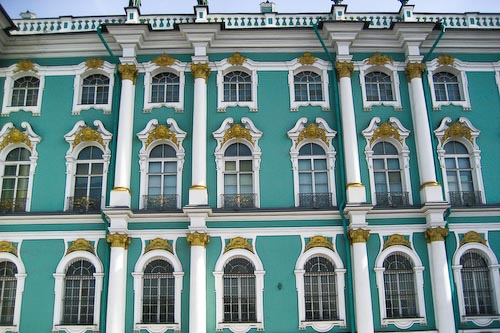
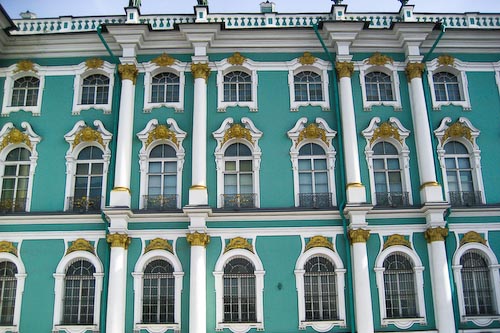
(Pic #1) The Winter Palace: Czarinas rule--in color.

Exploring Saint Petersburg–in living color

The first thing that strikes you as you navigate the bustling streets of St. Petersburg (the week of the annual St. Petersburg International Economic Forum) is the the mix of spirit-lifting colors on many of the 365 Imperial palaces here. Our tour guide, (a local historian with an enviable memory for detail) Zoye Tarasova, told me this region only gets “40 days of sun all year”–so it makes sense that the Czars and architects of the day (1700s) chose color to combat the sense of gray.

The Winter Palace and State Hermitage Museum sport what I  can only describe as Martha Stewart “Araucana Teal.” It’s not quite green, not quite blue–but a delicate mixture of the two. Now I’m sounding like Myrna Loy  in “Mr. Blandings Builds His Dream House.” If you missed that 1948 classic film with Cary Grant–I have to share the dialogue that always makes me smile. Mrs. Muriel Blandings (Loy) tries to describe to her house painters the kind of green she’d like in the living room, then the shade of yellow for the dining room…

                                     MURIEL
                         Now I want the living room to be a
                         soft green.
                                (PeDelford nods)
                         Not quite as bluish as a robin's
                         egg, but yet not as yellow as daffodil
                         buds.

                                     PEDELFORD
                         Mm.

                                     MURIEL
                              (handing him a sample)
                         The best sample I could get is a
                         little too yellow, but don't let
                         whoever mixes it go to the other
                         extreme and get it too blue. It should
                         just be sort of a grayish yellow
                         green.

                                     PEDELFORD
                              (making a note)
                         Mm-hmm.

                         (They turn to the dining room.)

                                     MURIEL
                         Now the dining room I'd like yellow.
                         Not just yellow, a very gay yellow.

                                     PEDELFORD
                         Mm-hmm.

                                     MURIEL
                         Something bright and sunshiny.
                              (sudden inspiration)
                         I tell you, Mr. PeDelford, if you'll
                         just send one of your workmen to the
                         A&P for a pound of their best butter
                         and match it exactly, you can't go
                         wrong.

                                     PEDELFORD
                              (making a note)
                         Mm.

                                     MURIEL
                         This is the paper we're going to use
                         here in the foyer.
                              (hands sample to him)
                         It's flowered but I don't want the
                         ceiling to match any of the colors
                         of the flowers. There are some voltaren little
                         dots in the background, and it's
                         these dots I want you to match. Not
                         the little greenish dots near the
                         hollyhock leaf, but the little bluish
                         dot between the rosebud and the
                         delphinium blossom. Is that clear?

                      (PeDelford looks carefully at the sample, then:)

                                     PEDELFORD
                              (making note)
                         Mm-hmm.

                                     MURIEL
                         The kitchen's to be white. Not a
                         cold, antiseptic hospital white -- a
                         little warmer but not to suggest any
                         other color but white.

                                     PEDELFORD
                              (note)
                         Mm.

                                     MURIEL
                         Now for the powder room, I want you
                         to match this thread.
                              (hands him thread)
                         You can see it's practically an apple
                         red. Somewhere between a healthy
                         Winesap and an unripened Jonathan.

                                     PEDELFORD
                              (making note)
                         Mm.

                        (There is a crash from the kitchen.)

                                     MURIEL
                         Will you excuse me?

               (Muriel hastily exits toward the kitchen. PeDelford turns to
               his assistant.)

                                     PEDELFORD
                         Got it, Charlie?

                                     CHARLIE
                              (deadpan; indicating
                              rooms with his thumb)
                         Green, yellow, blue, white, red.

                                     PEDELFORD
                         Check.

Almost all the Romanovs starting from Catherine the Great (a devoted supporter of the arts) resided in the Winter Palace–now home to the massive collection of the Hermitage Museum, which houses more than three million works of art and historical artifacts, including, the iconic “Dance” by Henri Matisse (Pic #6).
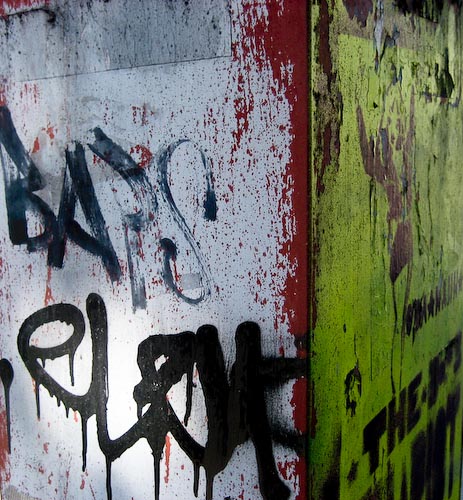
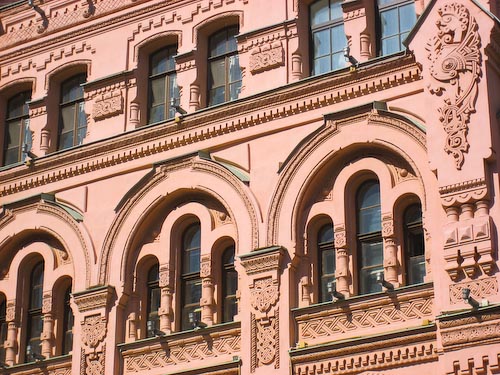
(Pic #2) Contemporary Russian street graffiti: color keeping pace with history

The distinctive shades of green, rust, dusty pinks, gold, and royal  blues–inside and out–in the palaces, cathedrals, museums, and on the streets, sent me spinning.
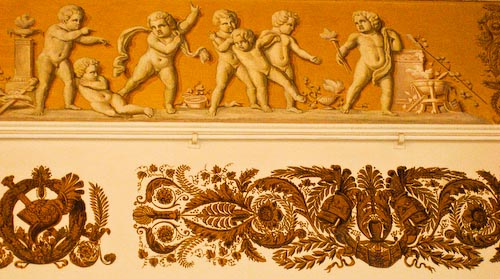
(Pic #3) Painted ceiling trim, Russian Museum, circa 1895

I started seeing colors I’d never seen before, and  interesting shapes and textures–everywhere. It’s why I had to stop to grab a few shots of Russian graffiti (Pic #2) on St. Petersburg streets and signs, as well as abandoned moorings in the Neva River. (Pic #4)

(Pic #4) Abandoned mooring, Neva River

Palace, church, and museum ceilings, walls, hallways, dishes, and Louis the XIV furniture, are all luxuriously adorned in gold. (Pic #7)

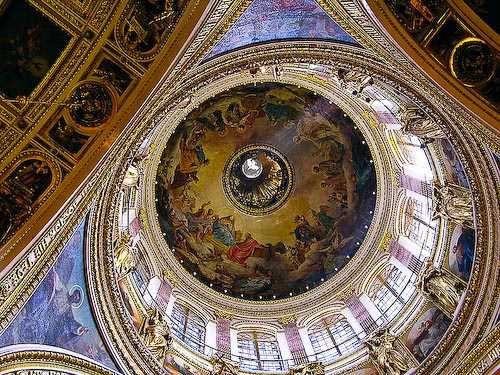
St. Isaac’s Cathedral took 40 years to complete–and once you see the art on the inside–you understand why. Many of the artisans who worked on the mammoth structure (1818-1858) never saw it completed. Check out  the painstaking work on the painted  dome that dominates the St. Petersburg skyline. (Pic #5).
I’m told one palace was painted a very specific shade of peach–because the czarina at the time favored a pair of peach colored gloves. I was born in the wrong era.

(Pic #5) St. Isaac's dome: Holy Spirit "dove" at center
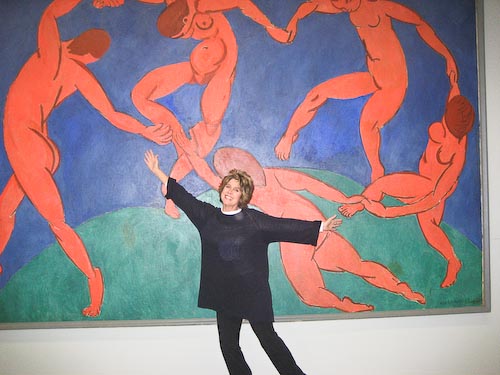
(Pic #6) My "Matisse moment"at the Hermitage
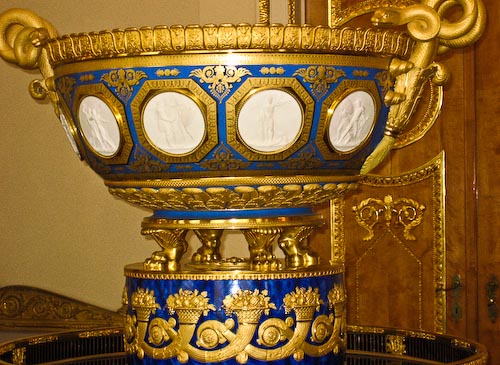
(Pic #7) Gold and lapis bowl, Russian Museum
Filed Under: Travel Tagged With: Catherine the Great, color moods, color obsession, decorating diva, Henri Matisse, Martha Stewart, Mr. Blandings, Myrna Loy, psychology of color, Russian art, Russian churches, Russian graffiti, St. Isaac's cathedral, St.Petersburg, the right color, unexpected art

Russia: First Impressions (Part 1)

July 14, 2010 by Lonnie Lardner

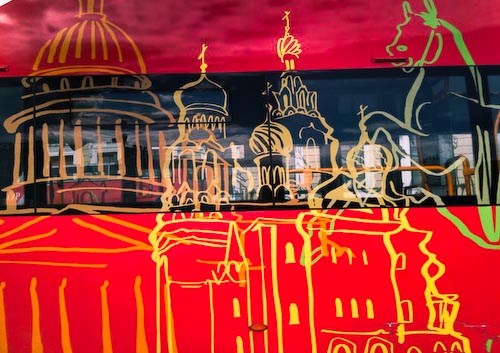
(Pic #1) Flash of red: Saint Petersburg city bus

Introduction to Saint Petersburg: “Venice of the North”

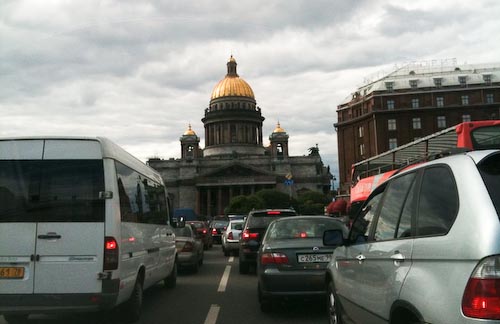
Writing this post from the storied riverbanks of the Russian host city for the Saint Petersburg International Economic Forum. For the last 14 years, the conference gathers over 2,500 political and business leaders, entrepreneurs, scholars, and the media to exchange ideas on pressing world economic issues and policies. The city is packed. The traffic—“just like home.”

(Pic #2) Entering Saint Petersburg, St. Isaac’s Cathedral

I’m not exactly what you would consider to be “an expert” in global economics—in fact, you might say my comprehensive economic policy can be summed up in two words–

“OVERDRAFT PROTECTION.”

So I’ll stick to what matters: cool art, jaw-dropping architecture, and a few fun fast-food facts. What? Just hang with me…

Brief history:

Saint Petersburg, (formerly Leningrad) was founded in 1703 by order of the Russian Emperor, Peter the Great. Initially, the town was developed as a fortress and seaport, but developed into a center of economic prosperity and industry.

(For the record, I’ve always wanted to be addressed as “The Czarina.” I picked the perfect city for that to happen. But it never did. I guess real Czarinas don’t wear Rocket Dogs.)

This very European looking city sits on the Neva River on dozens of islands, and–because of its cultural and historical treasures–this “northern capital” is also known as “Venice of the North.” (Saint Petersburg ceased being the capital after the Russian Revolution of 1917.)

I arrived during the region’s famous “White Nights” period, when it’s daylight–at midnight—in fact it’s daylight almost all night long–and a bit disorienting.  But all the more time to really “see” the city.

Highlights for me—as usual—are visual “moments.” When we arrived in the heart of the city, I was jolted by the red-painted city buses (top) and the lack of outdoor diclofenac advertising and signage bombarding most of us on city streets in the states.

But that doesn’t mean an American cultural icon can’t be an integral part of Russia’s burgeoning urban landscape.

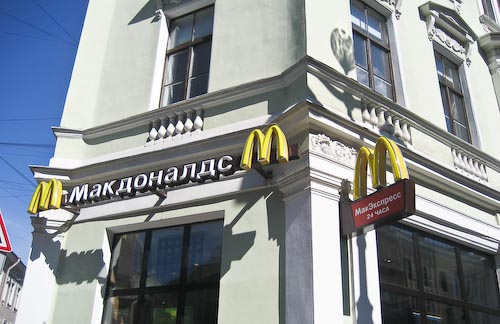
(Pic #5) Golden arches, golden smarches

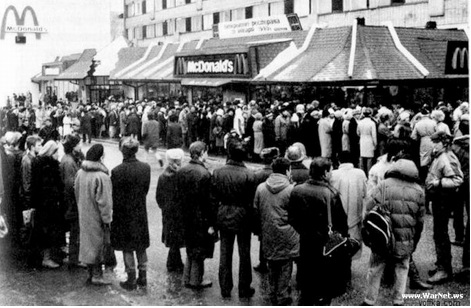
Russia is the fastest growing market for McDonald’s in Europe. (Pic #5) When McDonald’s fast food restaurants first landed here—it made headlines. The photos of the first McDonald’s opening in Soviet Russia 20 years ago led to a 7-hour wait (Pic #6) in Moscow. The black and white photo below confirms it was a mega hit. A total of 30,000 Soviet citizens tasted hamburgers and Coca-Cola on the food giant’s first day.

(Pic #6) McDonald’s in Moscow: 1990

Now that I’ve steered the train this far off the track—maybe you remember this exchange between Vincent and Jules in “Pulp Fiction:”

VINCENT

…You know what they call a Quarter Pounder with Cheese in Paris?

JULES

They don’t call it a Quarter Pounder with Cheese?

VINCENT

No, they got the metric system there, they wouldn’t knowwhat the f**k a Quarter Pounder is.

JULES

What’d they call it?

VINCENT

Royale with Cheese.

JULES

Royale with Cheese. What’d they Call a Big Mac?

VINCENT

Big Mac’s a Big Mac, but they call it “Le Big Mac.”

JULES

“Le Big Mac.” What do they call a Whopper?

VINCENT

I dunno, I didn’t go into a Burger King. But you know what they put on French fries in Holland instead of ketchup?

JULES

What?

VINCENT

Mayonnaise.

JULES

Goddamn!

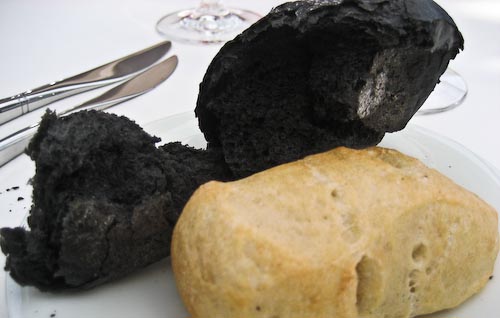
Eat it, or write with it: Yes, it’s really squid ink.

Okay, I didn’t opt for the Big Mac or the Little Mac. But I did have a chance to experience he quirkiest little bread plate I’ve ever been served (left) at the tony “Lumiere” restaurant overlooking Arts Square and The Cathedral of the Resurrection.

The Chef flavored the  dinner rolls with black SQUID INK.

Wasn’t sure if I should eat it — or use it to refill  my printer cartridge.

Filed Under: Travel Tagged With: Czarina, Fast Food, Impressions of Russia, Le Big Mac, McDonald's, Moscow McDonald's, Peter the Great, Pulp Fiction, Rocket Dogs, Russia, Russian architecture, Russian food, Russian history, Saint Petersburg, squid ink, St. Petersburg Economic Forum, Venice of the North, White Nights, Winter Palace

London Art: Inside and Out (Part 2)

July 1, 2010 by Lonnie Lardner

Sweet treats at the Tate

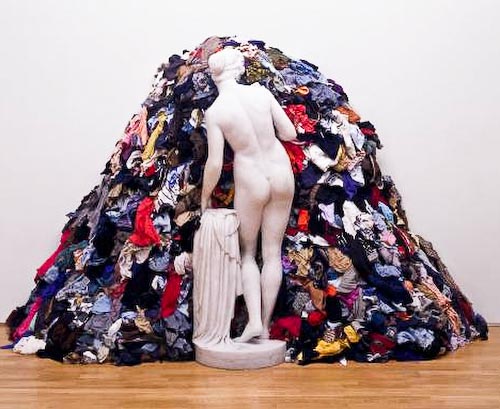
Pic #1: What to you mean you have nothing to wear?

I always love a good visual jolt.  Art–in any form–that takes me by surprise—always takes home the blue ribbon. I only had a few hours to view work at the Tate Modern, but every floor showcased little treasures I hadn’t seen before and some quirky pieces I’d only read about.

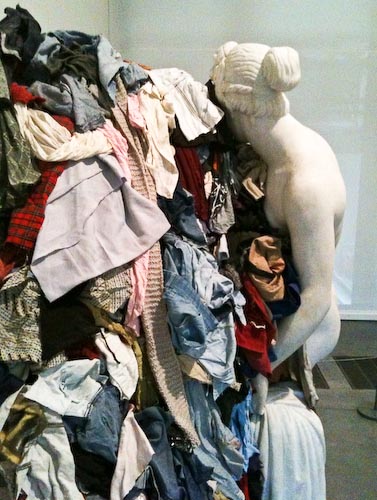
Pic #2 "Venus of the Rags" (detail) by Michelangelo Pistoletto

This piece (Pics #1 and  #2) titled, “Venus of the Rags,” cracked me up. It was assembled in 1967 by Italian artist Michelangelo Pistoletto (b. 1933). There’s so much going on in this installation, that even way across the museum floor it amuses passersby.

As the Tate describes, “Venus of the Rags” juxtaposes “an iconic figure of classical culture with the detritus of contemporary society”—as the Roman love goddess leans against a chaotic pile of gaudily colored worn-out clothes (actually used by the artist to clean his previous paintings). The truth is, the figure is based on a kitsch statue found in a garden center. And she reminds me just how much I hate doing laundry.

This bizarre mix of classical art and second-hand junk is a highlight of The Tate collection. It’s representative of the 60s movement  founded in Italy known as “Arte Povera”–artistic statements created from everyday life, often using “poor” materials.

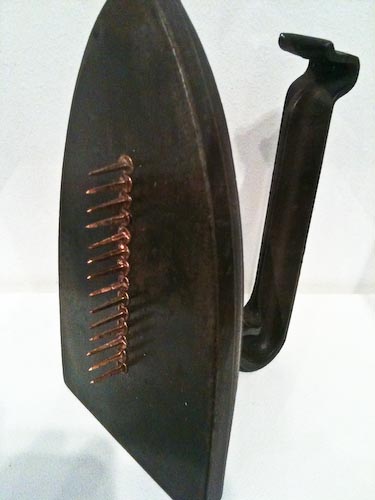
“Le Cadeau”

Hey, what's French for "re-gift?"

It’s the French word for “gift” and appears to be the perfect present for someone who needs to iron his mesh shirts.

Art historians tell us–by adding a row of nails–artist Man Ray transforms a household flat-iron into a new and potentially threatening object (right). “The sleeping aids nails and burning metal suggest a violent eroticism at odds with the work’s title.”  Gee, ya think?

Often described as a modernist,  Man Ray was a significant contributor to both the Dada and Surrealist movements along with conceptual genius Marcel Duchamp.

Duchamp was so iconic, award-winning Hollywood writer Aaron Sorkin worked him into trademark dialogue from NBC’s “The West Wing:”

C.J: “….an almost mind-blowing vortex of art and material that dares the viewers to recall Marcel DuChamp. Duchamp is the father of Dadaism.”

TOBY: “I know.”

C.J: “The Dada of Dada.”

TOBY: “It’s like there’s nothing you can do about that joke. It’s coming and you have to stand there.”

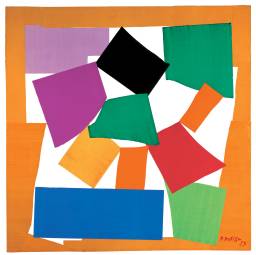
“The Snail” by Henri Matisse

Pic #4 "The Snail" by Henri Matisse

I happen to love an art lesson in one mindblowing moment. For me, this one is about breaking down an object  into its basic parts. Here, at 84, in the last year of his life, Henri Matisse cuts blocks of painted paper to create the centered spiral.

The minimalist “essence” of snail-–is clear—unless you’re my husband, who just walked in and looked at this and said, “How the hell to you see a snail in  that thing?”

“Carli” the fairy fashionista:

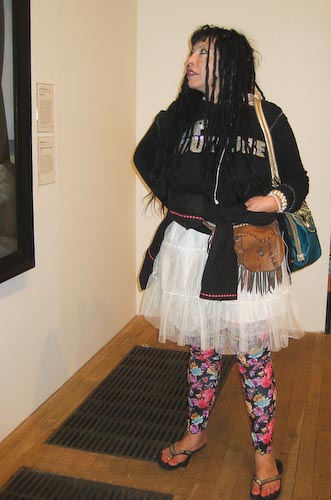
Sometimes, the “art” we see on the walls serves only as backdrop for the art we see everywhere else. Take “Carli” (Pic #5) –a creatively-dressed woman I encountered on the 3rd floor of the Tate. It made sense that she seemed to have stepped right out of her own fantasy world when I discovered she sells “fairly-traded faery wear” for children and adults. Her UK business card reads: “Clothes for all faeries, elves, pixies, nymphs, and gnomes.“

(Pic #5 ) Art "off the wall"


Filed Under: Travel Tagged With: Dadaism, fairy-wear, Henri Matisse, London art finds, London contemporary art, Man Ray, Marcel Duchamp, Tate Modern highlights, Tate Modern treasures, West Wing dialogue

  • « Go to Previous Page
  • Page 1
  • Interim pages omitted …
  • Page 3
  • Page 4
  • Page 5
  • Page 6
  • Go to Next Page »

Subscribe here:

Categories

  • Art Table Tips
  • Artist Spotlight
  • Creative Zone
  • Eco-Art
  • Found Art
  • Newsmakers
  • Quotes
  • Reflections
  • Travel
  • Uncategorized

Archives

Hey Brubeck, Take THIS.

The Alien And The Volcano: Why Do Our Brains Need to Make Order Out of Chaos?

Wait — So How Do YOU Choose a restaurant?

Meet Creative Voltage!

Sometimes Your Cat Just Makes The Art FOR You

2026: Kicking Fear to the Curb

Choosing Gratitude. But for a paintbrush?

Every Page Is A Treasure: Discovering Plastikcomb

Calling all artists — INKTOBER is here! Whaaaaa?

Art From The Ashes

One Click — One Masterpiece?

When Art F*cks With Your Head

The Perfect One-Liner

Portland: A Tale Of One City – Through Two Lenses

Happy New Year!

Allowing The Moment To Emerge

How Can A 5-Year-Old Be My Muse?

Stunning, Simple Beauty

An Unexpected Collaboration With Nature

Pathetic Shoe Obsession: WTF?

Copyright © 2026 · Dynamik-Gen on Genesis Framework · WordPress · Log in