The Lardner Report

Unleash your creative superpowers!

  • Home
  • Creative Voltage Website
  • Contact
  • Archives
  • About

An Eye for Dirty Art

March 28, 2011 by Lonnie Lardner

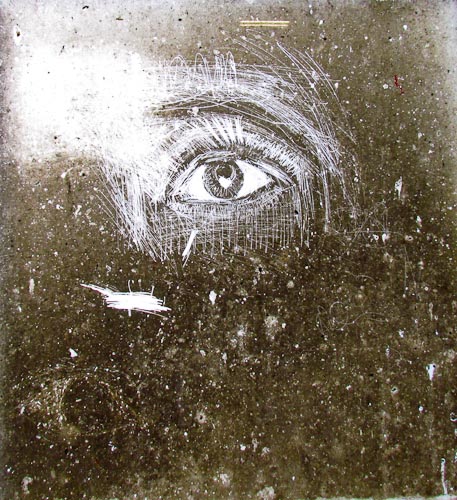
(Pic #1) The artist's eye: finding magic in the mundane

How one devoted artist showed me how to really seize the moment
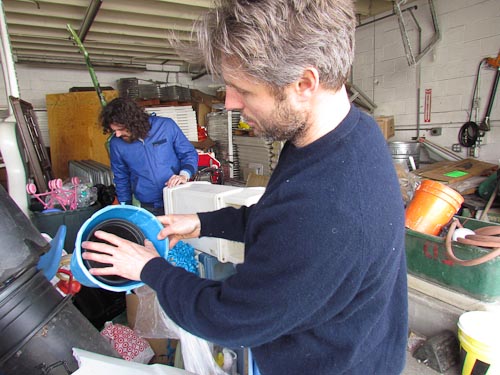
(Pic #2) Deininger: "Talking trash"

This week, I’m working on a mural for the City of West Hollywood, with a world-class environmental sculptor named Tom Deininger. He makes stunning wall reliefs out of consumer trash. Today we stopped by a sprawling city “dump” to root through garbage and tossed plastics Deininger needed to complete the piece. (Pic #2)

Immersed in the debris, and pressed by a tight schedule, Tom stopped in his tracks to tear across the warehouse floor to get a closer view of a filthy, rather unspectacular window. It had a gooey film of thick brownish gray residue from corner to corner.  And it was peppered with splotches and scratches cipro that let light seep through in interesting patterns.

Tom couldn’t wait to break out his own pen, turn it upside down, and start scratching his own design into this “blank canvas” of pure dirt. He just started sketching a pair of eyes he would later use for his mural design. (Pic #1)  I was inspired by his childlike enthusiasm to simply create.

He told me he just has “a peculiar instinct” to see the beauty in everything. It’s that fresh approach to familiar or ordinary surroundings that I adore. I’m convinced it’s what defines a true artist. But it’s my contention too, that we are all equipped with the those perceptual powers — as long as we are willing to allow them to interrupt our day.

“It’s not what you look at that matters, it’s what you see.” — Henry David Thoreau
Filed Under: Creative Zone Tagged With: an artist's eye, Eco-Art, environmental artist, painting on glass, seeing beauty in ordinary things, seizing the moment, Tom Deininger

Art from the Ashes: Finding Beauty in California’s Devastating Wildfires

November 28, 2010 by Lonnie Lardner

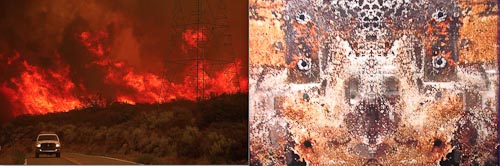
(Pic #1) Left: California Station Fire, photo credit: Genaro Molina, L A Times. (Pic #2) Right: Artwork from charred rubble from Santa Barbara Botanic Fire by Jonathan Chow

(Pic #3) Station Fire aftermath: Artists find meaning and elegance in debris. News photo credit: Luis Sinco, LA Times

As a former Los Angeles TV News reporter, I covered more wildfires than I would choose to remember–painful, sometimes deadly news events–that stick with me to this day. I can still see the flashes of horror and loss: panicked people–and pets–seeking safe ground, exhausted firefighters making one last run at a fierce wall of flames, as frightened neighbors pray their homes won’t be next. It’s almost impossible to describe what it’s like to witness that level of chaos and fear, but when I smell smoke, even today, it takes me right back to the scene.

So it was with a little trepidation I checked out a new art exhibit in Glendale, California. In a series of shows aptly titled “Art from the Ashes,” sculptors, painters, designers and craftsmen are invited to incorporate debris from Southern California wildfire sites into their artwork.

(Pic #4) Close-up: Cisco Home warehouse fire, South Central Los Angeles. Artwork/photo by Joy Feuer.

These fires tend to consume a staggering number of acres of mountain brush, and sometimes they insidiously fan out right through our neighborhoods. Last year’s Station Fire ravaged 250-square-miles of land, killed two firefighters, and destroyed 89 homes. On the face of it, there doesn’t seem to be much there to celebrate.

But artists see things differently. It’s what fascinates and inspires me. They see images, remnants, fragments and particles, in radically different ways. Once strained through their own filters, their interpretations can lead us onto new paths of understanding and appreciation.

(Pic #5) “Rights of Spring” installation from Station Fire by Ryan Wildstar

In “Art from the Ashes” we can see these translations as delicate, touching, and sobering reminders of the process of rebirth from a tragic thrashing of nature. In these ravaged communities and hillsides—if we’re amoxil open to it–we can find a strange beauty.

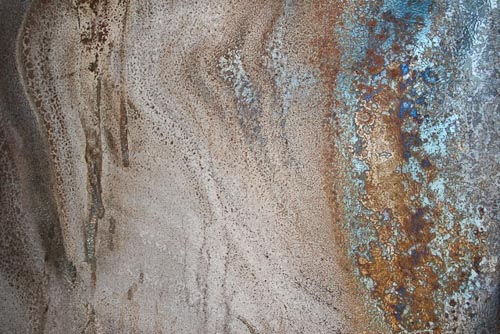
Check out the stunning patterns of burnt sienna and grays in Jonathan Chow’s photo of a corroded metal plant plaque recovered from the Santa Barbara Botanic Garden fire in May of last year (Pic #2, top), and the subtle patina that emerges from a rusted metal plate found and photographed by Joy Feuer (also founder of the non-profit organization, “Art from the Ashes”) in the Cisco Home Warehouse fire in South Central Los Angeles. (Pic #4).

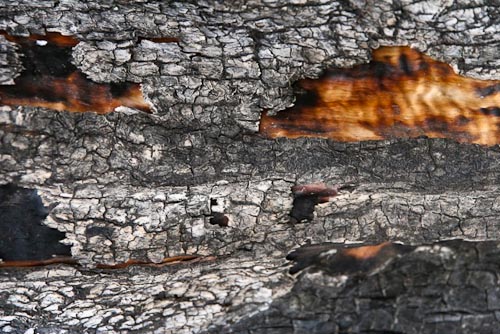
(Pic #6) Charred branch from Santa Barbara Botanic Fire. Artwork/photo by Joy Feuer.

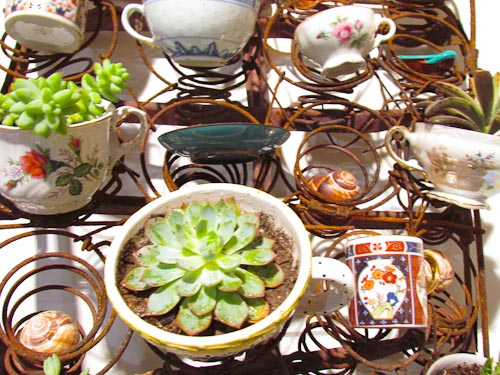
The simple patterns of cracked and charred branches from the Santa Barbara fire create textured rows of touchable shapes (Pic #6). Artist Ryan Wildstar transformed a burned, rusted metal spring frame recovered from a scorched Deukmejian Wilderness Park (a fire that burned 690 of the park’s 709 acres in September 2009) into a plant bed for native succulents (Pic #5).

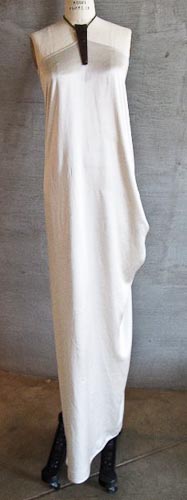
In last summer’s show, designer Corinne Grassini showed how fire can become sustainable, wearable art, by fashioning a minimalist white column dress with a decorative black neckpiece from charred debris salvaged from the park (Pic #7 ).


(Pic #7) Designer Grassini creates wearable art from ashes

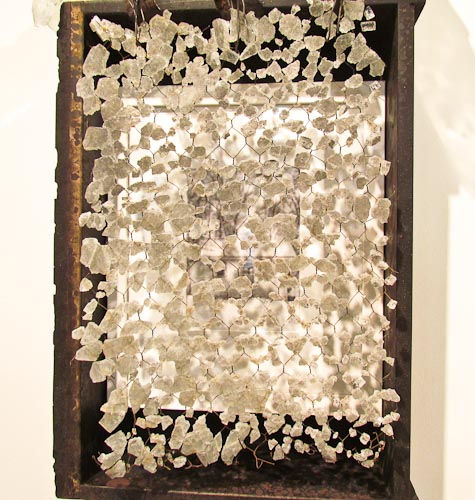
One of my favorite finds comes from the deliciously twisted mind of artist/actor Toby Huss — who places a displaced, scorched, wooden drawer up on the wall, under a snowy screen of shattered, melted glass and wire from two LA fires. (Pic #8) I couldn’t stop examining the clusters of glass, obscuring a printed image peeking from behind.

(Pic #8) Toby Huss crushed glass installation from two California wildfires

(You may know Huss from his work in film and TV. He’s one of my favorite comic actors, known for his quirky portrayals of Frank Sinatra, and for his voiceover work on the long running animated series King of the Hill. ) A profile on Toby planned for a future post in The Lardner Report.

Proceeds from “Art from the Ashes” benefits the communities and businesses devastated by fire. For more information, log on to: http://www.artfromtheashes.org


Filed Under: Eco-Art Tagged With: Art from ashes, art from the earth, artists create from wildfire debris, creative interpretation, Eco-Art, fresh approaches, Santa Barbara Botanic fire, Station fire, the artist's eye

Pasta Perfect Art

June 9, 2010 by Lonnie Lardner

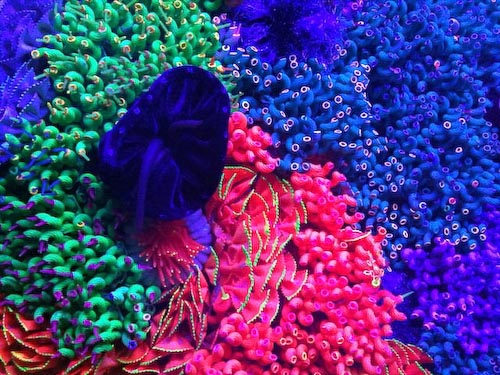
Pic #1 – Pasta Art: “Link” (detail) by Steven Simon, 2010
Dr. Atkins would probably hate this.

Steven Simon’s artwork cracks me up. You might say his latest installations are devoted to an all-carb diet. His medium is pasta. Simon is a dedicated environmentalist who uses his work to educate and inspire others—especially children–about the beauty, usefulness, and fragility of the world’s living coral reefs.

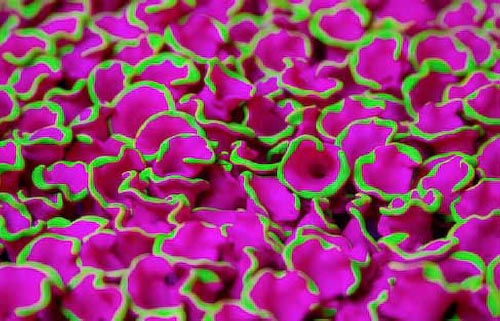
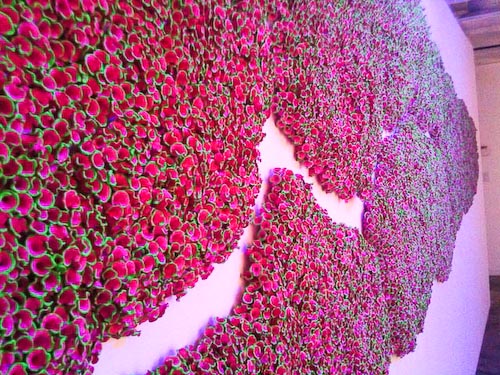
He’s also the guy who created a coral reef installation with 31,000 pieces of campanelle pasta (Pics #2 and #3 below). Each piece is hand-painted with brightly colored acrylic paint. Simon says he fell in love with campanelle’s  flower-like shapes—finding them to be the most perfect, realistic way to represent rich and vibrant reef life.

PIc #2 - Pasta Art: "There" (detail) by Steven Simon, 2010

We displayed this piece as a conversation stimulating backdrop for a FORTUNE “Brainstorm: Green” Conference at the Ritz Carlton, Laguna Niguel this Spring. Now, it’s on temporary display on the lobby level of the Ritz, next to the new, way cool fluconazole environmental education center, “Ambassadors of the Environment.”

The Ritz partnered with Jean-Michel Cousteau’s Ocean Futures Society to launch this unique educational program on Earth Day. Expert naturalists take guests on adventures through the natural wonders of the local seaside environment, including the kelp forests, tide-pools, and coastal bluffs.

Pic #3 Pasta Art (wide shot) "There" by Steven Simon

According to The Nature Conservancy, if the present rate of destruction continues, 70% of the world’s coral reefs will be destroyed by the year 2050–yet they are among the oldest ecosystems on Earth. Simon is hopeful his work will stimulate viewers into action in protecting our disappearing natural resources on land and in the sea.

Pictured on top, (Pic #1) Simon’s multi-colored “Link” installation, also made with pasta–from playful “bowtie” farfale, to utilitarian  macaroni. The “aquarium” holding the sculptural piece is 7 feet by 7 feet, and presents a window through which viewers can peek–and wonder–how the heck did he pull this off?

Ritz “Ambassadors of the Environment” Link: http://www.oceanfutures.org/news/press-releases/ambassadors-program-open-ritz-carlton-laguna-niguel

Steven Simon link: http://www.solarsculpture.com

Filed Under: Eco-Art Tagged With: artist Steven Simon, Eco-Art, environmental art, Jean-Michel Cousteau, Ocean Futures Society, pasta art, Ritz-Carlton Laguna NIguel

  • « Go to Previous Page
  • Page 1
  • Page 2
  • Page 3
  • Go to Next Page »

Subscribe here:

Categories

  • Art Table Tips
  • Artist Spotlight
  • Creative Zone
  • Eco-Art
  • Found Art
  • Newsmakers
  • Quotes
  • Reflections
  • Travel
  • Uncategorized

Archives

Hey Brubeck, Take THIS.

The Alien And The Volcano: Why Do Our Brains Need to Make Order Out of Chaos?

Wait — So How Do YOU Choose a restaurant?

Meet Creative Voltage!

Sometimes Your Cat Just Makes The Art FOR You

2026: Kicking Fear to the Curb

Choosing Gratitude. But for a paintbrush?

Every Page Is A Treasure: Discovering Plastikcomb

Calling all artists — INKTOBER is here! Whaaaaa?

Art From The Ashes

One Click — One Masterpiece?

When Art F*cks With Your Head

The Perfect One-Liner

Portland: A Tale Of One City – Through Two Lenses

Happy New Year!

Allowing The Moment To Emerge

How Can A 5-Year-Old Be My Muse?

Stunning, Simple Beauty

An Unexpected Collaboration With Nature

Pathetic Shoe Obsession: WTF?

Copyright © 2026 · Dynamik-Gen on Genesis Framework · WordPress · Log in