The Lardner Report

Unleash your creative superpowers!

  • Home
  • Creative Voltage Website
  • Contact
  • Archives
  • About

When Fish Become Abstract Art

December 31, 2016 by Lonnie Lardner

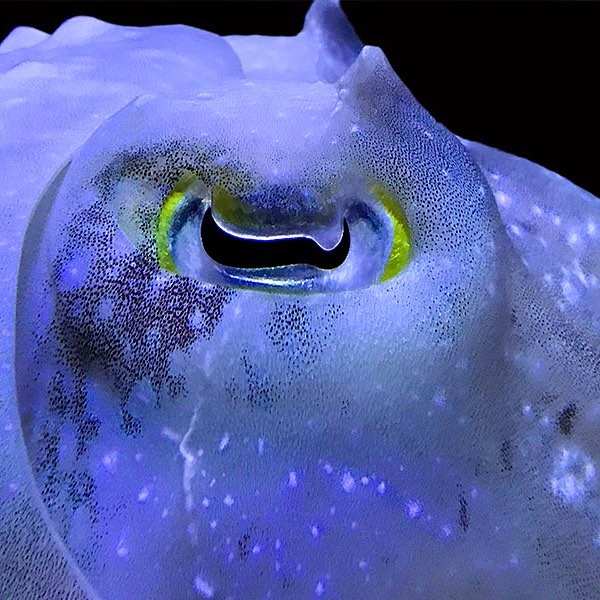
(Pic #1) The watchful eye of a deep sea Cuttlefish. Shot by Lori Pond via iPhone at the Monterey Bay Aquarium.

Somewhere between sea monster and masterpiece.

My artist friend Lori Pond recently made a quick trek up north and came back with some astonishing images. Creatures from the deep sea, providing gestures, texture, and color that accomplished painters would kill to create.

Lori said she had a magical moment with a Cuttlefish at the Monterey Bay Aquarium (Pic #1), when she cozied up to the glass — and he bellied up to the babe. He was less than 2-feet long, and that’s his eye dead center in the photo. Experts say these curiosities only live about 18 months, and they are described as “very emotional.” I am so taken by this close-up, with all its interesting patterns and visual gifts. Even his curvy black eye could pass for a Matisse paper cut-out.
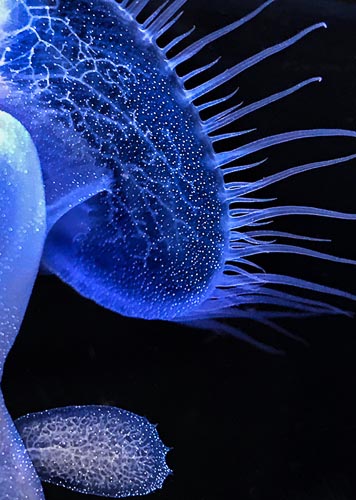
(Pic #2) Close-up, Blue Jelly. Photo by Lori Pond.

Technically, Cuttlefish are not fish — they are marine animals of the order “Sepiida,” and belong to  the class “Cephalopoda,” which includes squid, octopuses and nautiluses. They have eight arms, and they hold the record for fastest color change — shifting hue in an instant — given a perceived yasmin threat. They have amazing eyesight, and can shoot out ink; they have jet propulsion, stalk their prey sideways, and are master hunters. I think I’m in love.

The Blue Jellyfish Lori captured are just as beautiful, from an artistic standpoint. (Pic #2) They give me a sense of floating flowers with fresh young petals reaching out toward the sun. The Monterey Bay Aquarium says jellies are the biggest attraction for its two million visitors a year. And for those who can’t make it, they provide a 24/7 LIVE JELLY CAM.

Art inspired by nature is nothing new. Lori says she pays homage to iconic illustrator/biologist Ernst Haeckel with every shot she took. (You may recognize his style in Pic #7.) I think the beauty lies in the unexpected  — the detail on a fin or a face, the neon lights emerging from a jelly’s belly like iridescent spaceships. Once again, whether she knows it or not, nature surrounds us — and supplies us — with an infinite source of creativity.
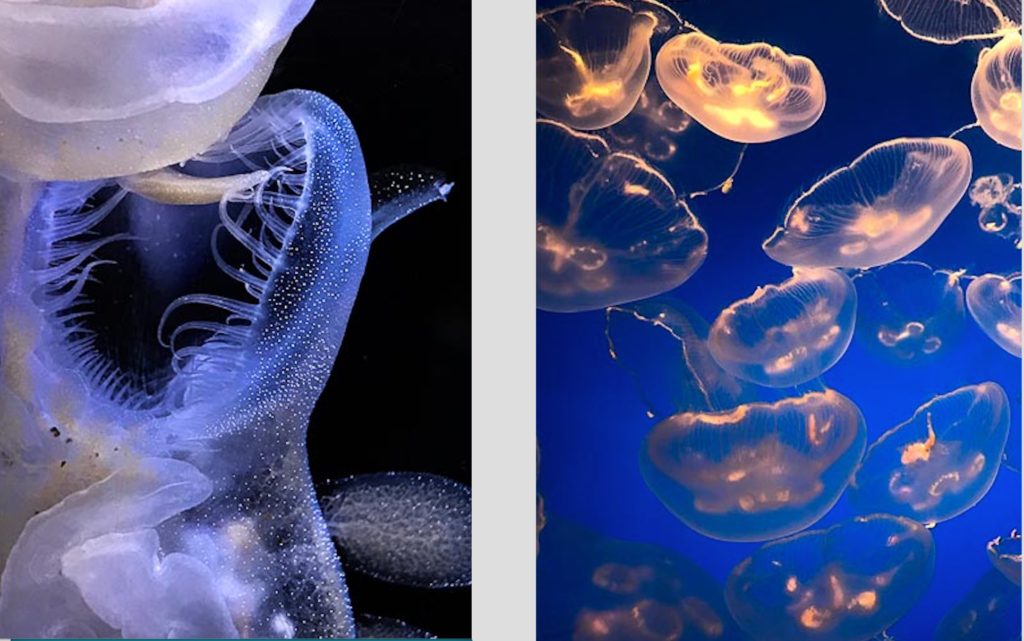
(Pic #2 and #3) Jellies at the Monterey Bay Aquarium. Photos by Lori Pond.
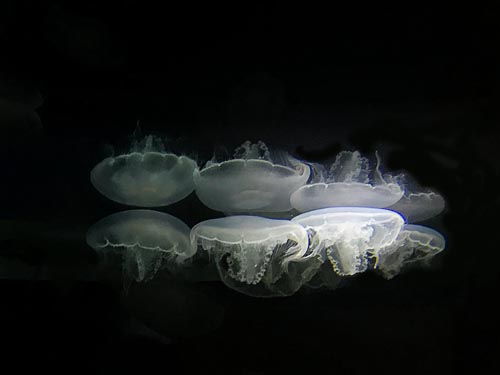
(Pic #5) “Reflective Jellies.” Photo by Lori Pond. Oregon Coast Aquarium in Newport, Oregon.
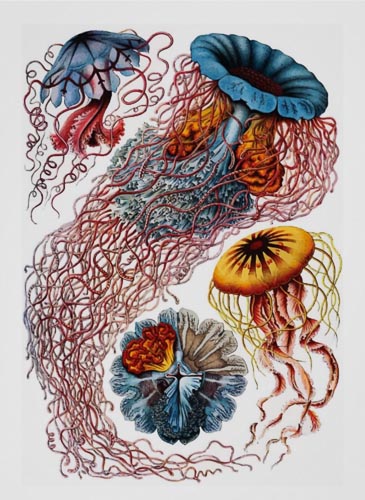
(Pic #7) Victorian era illustration, Jellyfish, by Ernst Haeckel.
Filed Under: Found Art Tagged With: art in nature, art underwater, cuttlefish, fish as abstract art, Haeckel art, jellyfish, Monterey Bay Aquarium

Today’s Pic: Discovering Nature’s Stunning Art Show

August 31, 2015 by Lonnie Lardner

Mail Attachment

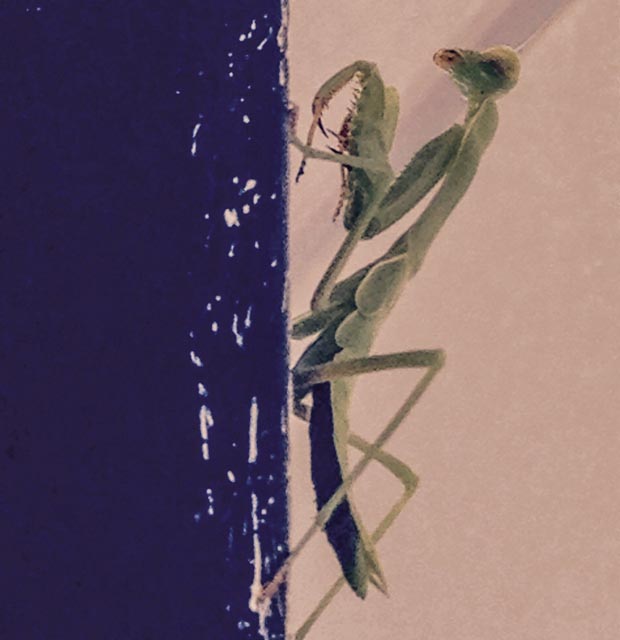
(Pic #1) Praying Mantis captured by Amy Eyrie in Calabasas, California

It’s never about “looking” for the moment — it’s about being receptive to it.

My yoga teacher Amy Eyrie has walked past this iron gate hundreds of times. She passes it every time she teaches a class at our gym. On this day, she noticed something different, and decided to grab her iPhone. She stopped to take the obligatory wide shot to document the occasion, and then realized there was something else going on: Art in the making.

Closing in, Amy saw the two planes of color xanax (left: violet, and right: dusty rose) showcasing the delicate beauty of this insect’s willowy limbs. She zoomed in, and captured this “painting” with perfect composition and line. The color was not altered here. And it may not be coincidence that the mantis’s underbelly matched the deep purple of the gate. It’s the perfect alignment of timing, light, and photographer’s instinct.

I sort of think nature wants us to discover her creative moments. It’s how she can connect with us and earn our respect. We just have to be kind enough to notice.

Filed Under: Found Art Tagged With: art in nature, capturing moments, iPhone photography, nature photography, praying mantis

The Art Of The Nest

March 22, 2012 by Lonnie Lardner

Nature's tiniest artist: Mother hummer prepares her nest with "found objects." Photo by Josh Kaplan.

Hummingbird Mom builds a functional home — and a stunning work of art.

She’s sitting in her flawlessly-crafted nest this very moment. Mother hummer has chosen the bougainvillea vine on our front patio as her maternity ward. We’ve decided to enter our house through the back door now because we don’t want to disturb her. After all, the gestation period for hummingbird babies is just 18 days. Last year she flew in (most likely from Mexico) to lay and incubate her two pea-sized eggs — but she unexpectedly left — without seeing her young break through. She’s back, and we want to make her stay as comfortable as possible.

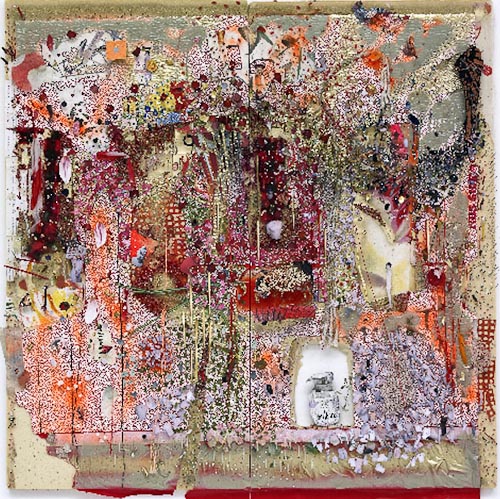
The factoids on these magnificent creatures (listed below) may be sobering, impressive, and just hard to believe — but to me, the real story is the art and architecture emerging out of a bird that weighs less than a penny. I cannot stop examining the structure and beauty of this inch-and-a-half wide thriving little cup of nature. Our spotted “rufous” hummingbird has gathered the most delicate of leaves, dainty flower petals, and flexible twigs. She has camouflaged them with bits of lichen, and spun and glued the “found objects” together with borrowed spider webs. She has created one of the most intricate, and interesting functional collages I’ve ever seen. (Except maybe those of artist Elliot Hundley, Pic #2.)

Much like the work of contemporary “fiber artists” (Pic #3) Mother has sculpted a sort of free-form design with her organic materials, with the added benefit of a solid foundation on which she can raise her family.

Ten days to go. I’m a wreck.

(Pic #2) Assemblage of accumulated bits of lo-fi media, i.e., string, paper, photos and beading. By artist Elliot Hundley.

Pic #3 (Left): "Moth study" by fiber artist Erin Riche. (Right): Detail of crochet art by Margaret Hubert.

Just the Facts:

  • A hummingbird’s heart beats up to 1,260 times per minute.
  • While diving, her wings will beat up to 200 times per second.
  • She will take about 250 breaths per minute –while at rest.
  • They are the only birds who can fly forward and backward.
  • Some hummingbirds will travel over 2000 miles twice a year.
  • To extract nectar, she will visit an average of 1,000 flowers per day.
  • When hummingbirds sleep at night, they go into a hibernation-like state called torpor.
  • A hummingbird’s favorite color is red.


Filed Under: Found Art Tagged With: Ann Maki, art in nature, bird nests, collage, Elliot Hundley, fiber art, found object art, hummingbird facts, hummingbirds, Margaret Hubert, nature's artist, organic sculpture

  • « Go to Previous Page
  • Page 1
  • Page 2

Subscribe here:

Categories

  • Art Table Tips
  • Artist Spotlight
  • Creative Zone
  • Eco-Art
  • Found Art
  • Newsmakers
  • Quotes
  • Reflections
  • Travel
  • Uncategorized

Archives

Hey Brubeck, Take THIS.

The Alien And The Volcano: Why Do Our Brains Need to Make Order Out of Chaos?

Wait — So How Do YOU Choose a restaurant?

Meet Creative Voltage!

Sometimes Your Cat Just Makes The Art FOR You

2026: Kicking Fear to the Curb

Choosing Gratitude. But for a paintbrush?

Every Page Is A Treasure: Discovering Plastikcomb

Calling all artists — INKTOBER is here! Whaaaaa?

Art From The Ashes

One Click — One Masterpiece?

When Art F*cks With Your Head

The Perfect One-Liner

Portland: A Tale Of One City – Through Two Lenses

Happy New Year!

Allowing The Moment To Emerge

How Can A 5-Year-Old Be My Muse?

Stunning, Simple Beauty

An Unexpected Collaboration With Nature

Pathetic Shoe Obsession: WTF?

Copyright © 2026 · Dynamik-Gen on Genesis Framework · WordPress · Log in