The Lardner Report

Unleash your creative superpowers!

  • Home
  • Creative Voltage Website
  • Contact
  • Archives
  • About

My Mystery Minimalist

February 28, 2019 by Lonnie Lardner

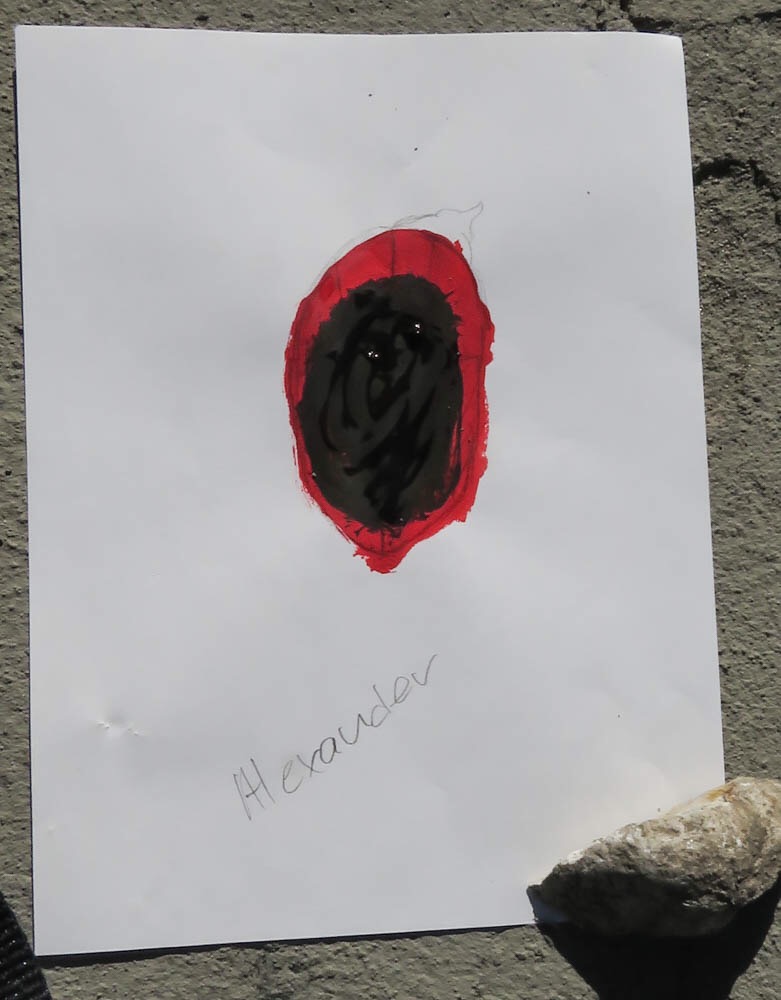
(Pic #1) Little Alexander’s minimalist contribution to our art workshop. For him, it was more about what not to paint.

For the last 30 years I’ve had the joy of running art workshops for hundreds of inner-city kids in South Central LA.  Each session offers a chance for every child to express his most creative instincts. There are no rules. No instruction. Just a few hours of unbridled artistic energy.

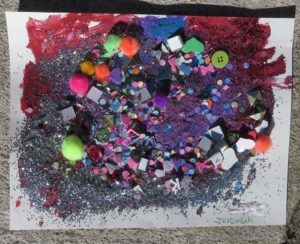
(Pic #2) Fearless self expression in paint, metallic powders, cotton balls, and buttons.

With that kind of freedom, we typically witness franetic applications of paint, glitter, confetti, stickers, beads and, well, pretty much anything that glue can keep on the page. (Pic #2) Layers upon layers of color, texture, and goo. It’s almost as if it’s their last day on earth, and if they don’t load up their artwork with 16 pounds of “stuff” there will be no trace they even passed through.

So when I spotted the pure red and black minimalist painting above, I freaked. Kids don’t do that. If there are jars of glitter and glue, they will be emptied. Paints are poured, poured again, and almost nothing is left on the table.
Minimalism is defined as a 1950s abstract art movement whose pieces “minimize distractions and focus on only what matters.” The boy who painted the minimalist piece on top apparently gets that. In fact, I think it takes a certain discipline and clarity of thought to eliminate objects from a painting instead of adding them.

My only regret is that I didn’t get to meet this young Ellsworth Kelly.  He apparently skipped out and left his work on the sidewalk. Another perfect artist move.


Filed Under: Creative Zone Tagged With: Abstract art, art for kids, Ellsworth Kelly, inner-city kids, kids' art, minimalism, minimalists, young artists

How Picasso Redesigned Apple, Inc. — And Our Lives

January 31, 2019 by Lonnie Lardner

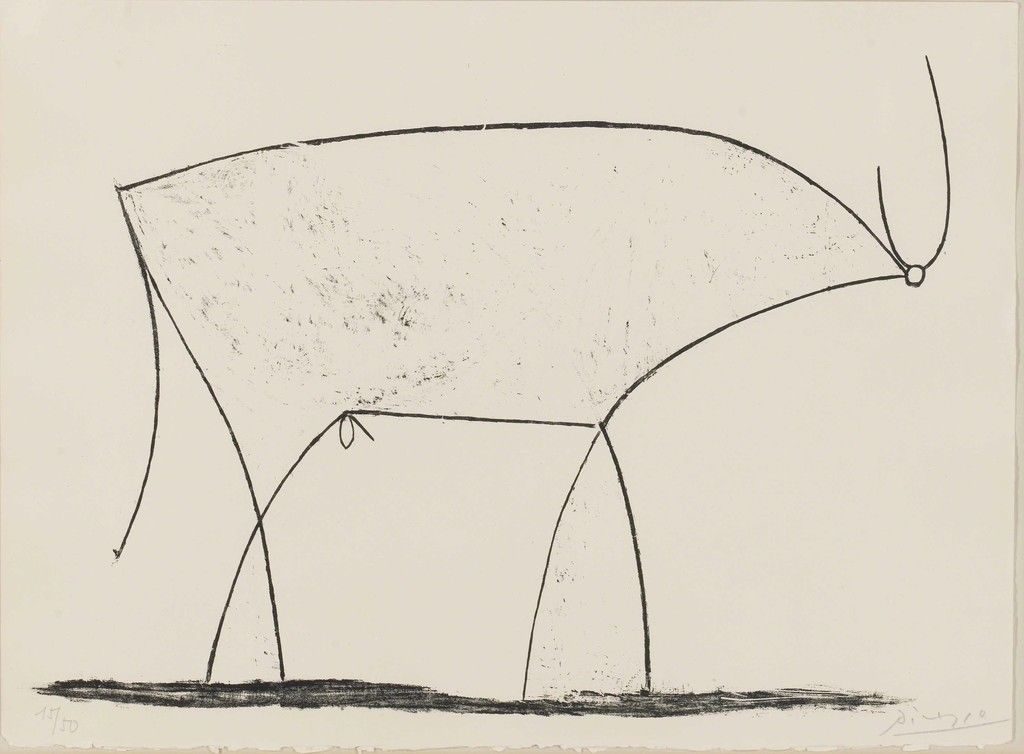
(Pic #1) The Bull, Lithograph by Pablo Picasso, 1945 / Inspiration for Mac sleek.

Twelve lines — and there it was.

It seems almost impossible to fathom, but just one defiant Spanish artist revolutionized the way a multi-billion dollar industry designs its products, and changed the way we all work. Pablo Picasso, the irreverent, most trailblazing painter and sculptor of the 20th century, continues to shape style and function, nearly half a century after his death.
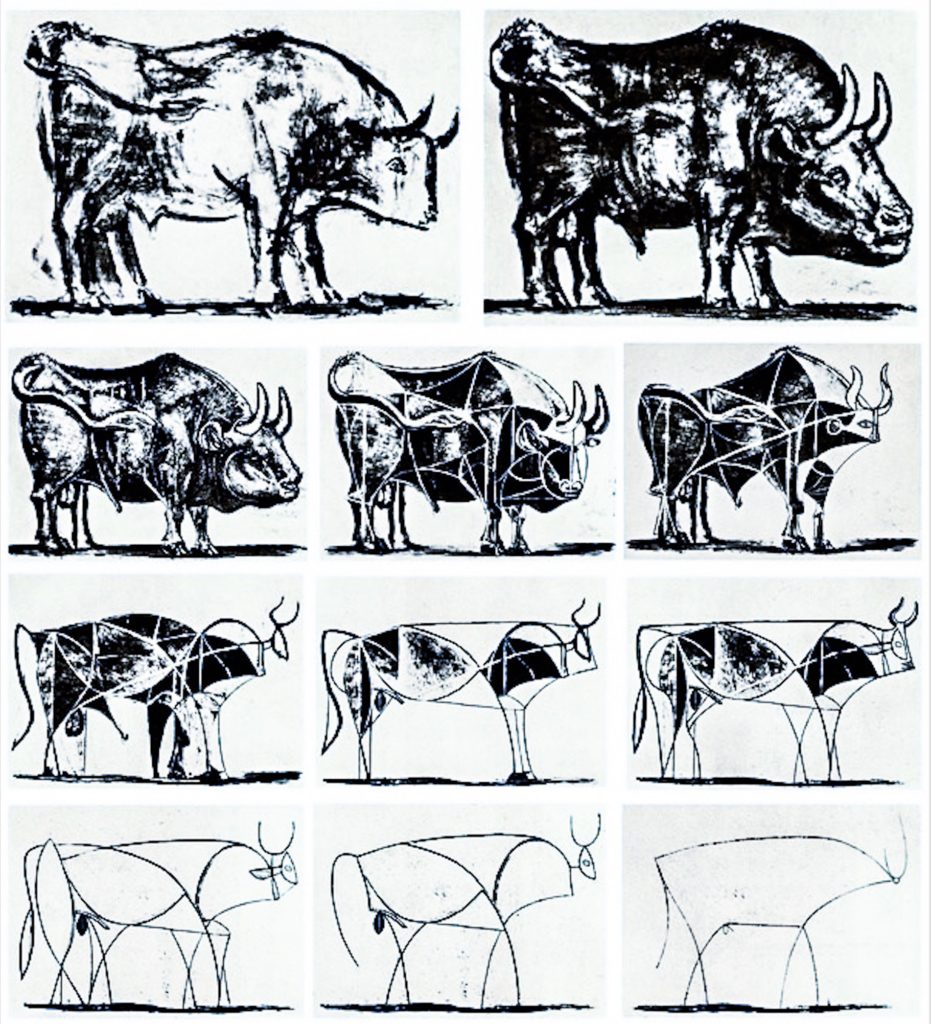
The series of bull drawings below, explain how. And why Apple, Inc. is still “all in.”

(Pic #2) “The Bull” (lithograph series) Pablo Picasso, 1945

Picasso pretty much defined minimalism through these eleven drawings…starting with a fairly realistically rendered bull up top, and ending with a handful of lines that evoke the animal’s “essence” at the bottom. The series is a step-by-step illustration of how to break an image down into its most basic parts.

Today, Apple incorporates these lithographs into its internal, highly secretive training program.

(Pic #3) Steve Jobs: “Let’s make it simple. Really simple.”

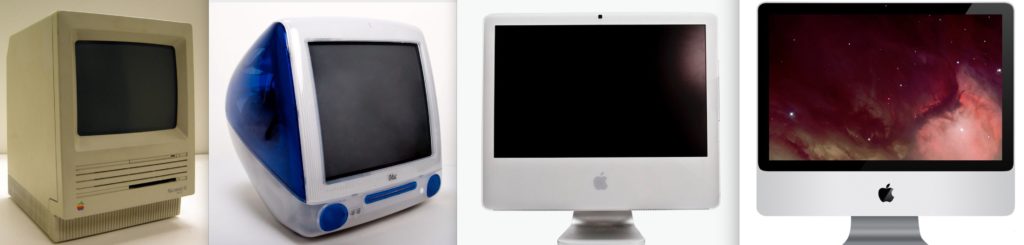
Jonathan Ive, head of design under Steve Jobs, describes the process of creating one of Apple’s Power Macs: “We wanted to get rid of anything other than what was absolutely essential,” he said. “We kept going back to the beginning, again and again. Do we need that part? Can we get it to perform the function of the other four parts?”
+++++++++++++++++++++++++++++++++++++++++++++++++++++++++++++++++++++++++++
The relationship between Apple and the prolific painter was exposed in a New York Times article in 2014. The Apple Uiniversity course on communication (taught by Randy Nelson, the former dean of Pixar University) focused on all 11 versions of “The Bull.” His point was: you rip through dozens and dozens of iterations until you can simply deliver your message in a concise way. The Apple brand has stayed true to that philosophy, ever since.
As the former Apple CEO explained: “The way we’re running the company, the product design, the advertising, it all comes down to this: Let’s make it simple. Really simple.”
+++++++++++++++++++++++++++++++++++++++++++++++++++++++++++++++++++++++++++

Fun fact: Steve Jobs was influenced by 20th-century European artists. In fact, the original Mac logo from 1984 was inspired by Picasso’s contemporary and sometimes rival, Henri Matisse.


Filed Under: Artist Spotlight, Newsmakers Tagged With: Apple, artist influence, design, inc., Picasso, Steve Jobs, tech design

Desert Junk: The Art of Change

December 31, 2018 by Lonnie Lardner

(Pic #1) A whimsical meshing of sheet metal and coil by Noah Purifoy. Joshua Tree Outdoor Museum, Mojave Desert, California. (Photos by Josh Kaplan)

How one radical sculptor changed the Southern California landscape.

At first glance, you can’t help but say, “Wait, what?” Then you begin to explore the work — and its poignant themes — and you realize you’re in the midst of something big. The artist’s name is Noah Purifoy — an African-American born in 1917 in the segregated south — with an extraordinary gift for creative expression and sobering commentary.

I could have wandered to 10-acre installation for days. Each turn I felt a sense of glee, as if I were the first visitor to this extraordinary gallery under the sun. The sculptures appear to be just as dramatic as I imagine they were when they were installed. Maybe even more so, as they become weathered and decayed — showing new layers of color and texture — over the last 30 years.

(Pic #2) Artist Noah Purifoy in his Los Angeles studio in 1970.

”From the Point of View of the Little People” (1994) is probably Purifoy’s most famous construction (Pic #7 below): a row of weathered jeans, boy-sized, “standing” over sneakers and placed in a row on an elevated ramp. Experts say this might be another visual reference to the practice of lynching, as in a larger piece titled, “Gallows.” (Pic #8).

Most of the time Purifoy started with found objects collected from the streets of Los Angeles. Later, when he moved to the desert, people started offering him things, knowing he was “looking for junk.” The artist once said, “The object turned into an idea.”

From 1987 until his death in 2004, Purifoy built over 100 environmental sculptures in Joshua Tree. The fierce desert winds and unforgiving heat have taken their toll on his work, but he always acknowledged that they would experience change. He seemed to have no issue with that — as he was quoted as saying, “I do artwork, I don’t do maintenance.”

Honestly, based on that statement alone, Noah Purifoy just might be the coolest artist I’ve never met.

+++++++++++++++++++++++++++++++++++++++++++++++++++++++++++++++++++++++++++++++++++++++++++++++++++++++++++++++++++++++++

Did you know? Noah Purifoy also co-founded the Watts Towers Arts Center in 1964.   Please scroll down for the complete photo collection.

(Pic #3) TV Land installation by Noah Purifoy.

(Pic #4) Sculptures by Noah Purifoy. Right: “Old Volks at Home.” (1994)

(Pic #5) Installation by Noah Purifoy. (Right)

(Pic #6) “Aurora Borealis” Installation (1999-2000) by Noah Purifoy

(Pic #7) “From the Point of View of the Little People” by Noah Purifoy. (1994)

(Pic #8) “Gallows” by Noah Purifoy. (2003) The last piece constructed before he died. Photo courtesy The Noah Purifoy Foundation / Joshua Tree Outdoor Museum.

(Pic #9) Metal sculpture by Noah Purifoy.

(Pic #10) “Gas Station” (1992) Photo courtesy The Noah Purifoy Foundation / Joshua Tree Outdoor Museum.

(Pic #11) Sculpture and totem by Noah Purifoy.

(Pic #12) Sculpture by Noah Purifoy.

(Pic #13) “No Contest” (1991)

(Pic #14) Sculpture by Noah Purifoy.

(Pic #15) Installation by Noah Purifoy.

(Pic #16) Archway by Noah Purifoy.

(Pic #17) Yes, these are what you think they are. Sculpture by Noah Purifoy.

(Pics 18 + 19) Installations by Noah Purifoy.

(Pic #20) “Quonset Gallery, 1990s” installation by Noah Purifoy.

(Pic #21) Classic Joshua Tree, and a hut to die for.

(Pic #22) Whatever is left of a fabric-wrapped totem.

Filed Under: Artist Spotlight, Found Art Tagged With: art, desert art, desert junk, Eco-Art, environmental art, environmental sculpture, Joshua Tree outdoor museum, Noah Purifoy, sculpture, Watts Towers Art Center

  • « Go to Previous Page
  • Page 1
  • Interim pages omitted …
  • Page 24
  • Page 25
  • Page 26
  • Page 27
  • Page 28
  • Interim pages omitted …
  • Page 85
  • Go to Next Page »

Subscribe here:

Categories

  • Art Table Tips
  • Artist Spotlight
  • Creative Zone
  • Eco-Art
  • Found Art
  • Newsmakers
  • Quotes
  • Reflections
  • Travel
  • Uncategorized

Archives

Hey Brubeck, Take THIS.

The Alien And The Volcano: Why Do Our Brains Need to Make Order Out of Chaos?

Wait — So How Do YOU Choose a restaurant?

Meet Creative Voltage!

Sometimes Your Cat Just Makes The Art FOR You

2026: Kicking Fear to the Curb

Choosing Gratitude. But for a paintbrush?

Every Page Is A Treasure: Discovering Plastikcomb

Calling all artists — INKTOBER is here! Whaaaaa?

Art From The Ashes

One Click — One Masterpiece?

When Art F*cks With Your Head

The Perfect One-Liner

Portland: A Tale Of One City – Through Two Lenses

Happy New Year!

Allowing The Moment To Emerge

How Can A 5-Year-Old Be My Muse?

Stunning, Simple Beauty

An Unexpected Collaboration With Nature

Pathetic Shoe Obsession: WTF?

Copyright © 2026 · Dynamik-Gen on Genesis Framework · WordPress · Log in