The Lardner Report

Unleash your creative superpowers!

  • Home
  • Creative Voltage Website
  • Contact
  • Archives
  • About

The Fish That Makes Art

January 31, 2016 by Lonnie Lardner

True love found 80 feet down on the ocean floor.
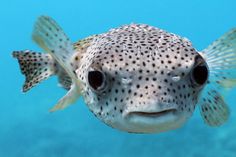
Puffer close upjpg

(Pic #1) Close-up, creative pufferfish.

I think my husband could be a slacker. Look what this minuscule (5-inch) creature can pull off — in 10 days’ time —  to attract a mate.  Josh is always trying to find new ways to court me,  and I think I need to share this report.

Not long ago, off the southern tip of Japan, a dedicated oceanic photographer named Amami Oshima discovered what he initially called a “mystery circle” —  a shockingly intricate, rippling geometric pattern nearly 6-feet wide on the ocean floor.  Well it turns out, the master architect of this stunning example of “environmental art” is a tiny pufferfish.  He creates the mandala-like nest with his fins, digging furrows to attract the attention of passing female puffers (Click video, above.)

Before the female fish arrives to inspect his handiwork, the male forms quirky patterns in the fine sand of the central circle. He also decorates the peaks of the outer portion with shells and fragments of coral. (In contemporary art, we would tramadol call this texturizing or creative use of “found objects.”) Scientists believe, “when a potential female partner arrives on the scene, the male stirs up the fine sand in the nest’s inner circle. If she deems the nest (and the male who built it) satisfactory, she lays her eggs and leaves.”
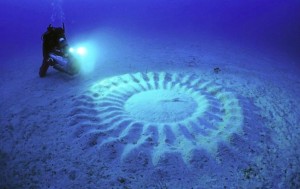
Photographing puffer copy JPG BBC

(Pic #2) For a sense of scale: A male pufferfish (center) photographed by crew in 2012. Photo courtesy Kimiaki Ito.

Experts aren’t sure exactly what the females are looking for when they assess a male’s nest. It could be the patterns of fine sand, the decorations on the outside, or the nest’s size or perfect symmetry. But they do know that because the process is so time-consuming, a larger nest could indicate a stronger or “more fit”male suitor — both desirable traits to females.

Dudes: Take note.

FISHY FUN FACT: According to the National Oceanic and Atmospheric Administration less than five percent of the world’s oceans have been explored, meaning that 95% of what lies deep underwater on Earth has yet to be seen by human eyes.
Filed Under: Eco-Art, Found Art, Newsmakers Tagged With: fish who make art, male-female attraction, nature under the sea, nest-making, oceanic crop circles, oceanic mysteries, pufferfish

Environmental Art “Hits The Wall” In West Hollywood

April 13, 2011 by Lonnie Lardner

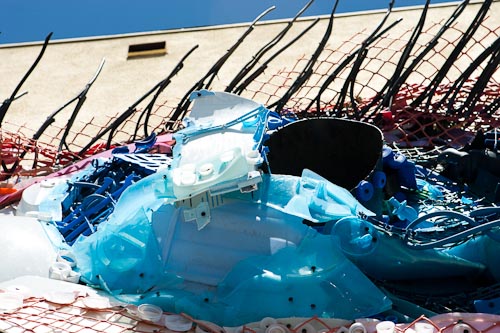
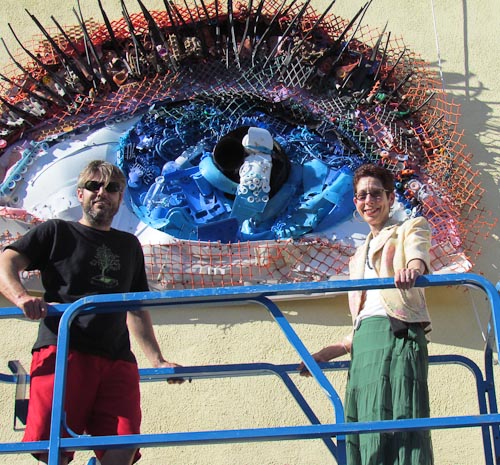
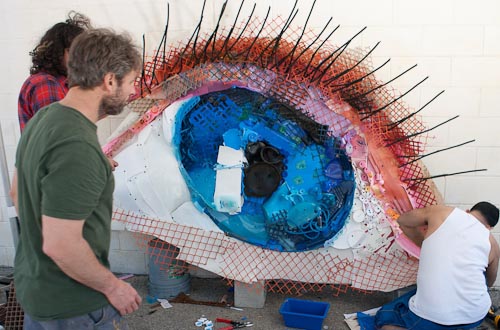
Eco-artist Tom Deininger transforms trash into artistic treasure in West Hollywood. Check out the “reflection” in the pupil–a junked white coffeemaker.

Local pre-school saves toys — makes art

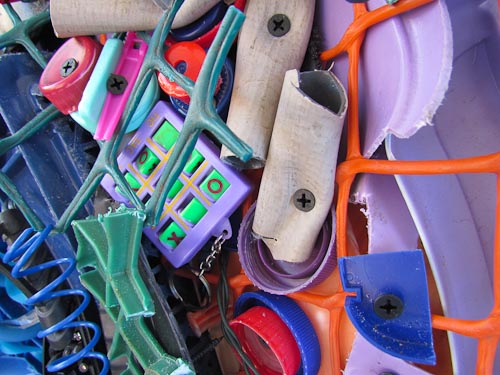
Close up: new life for trashed toys

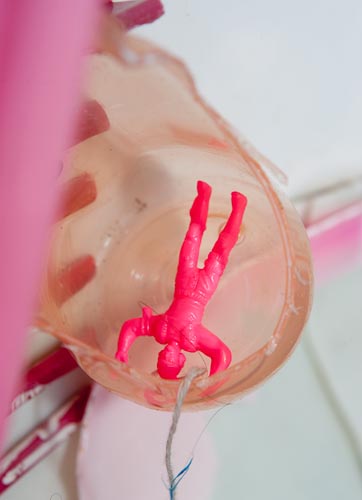
Hot pink action figure provides a pop of color

Yes, we’re talking trash. The kind you can reclaim, recycle, or reuse.  It’s what stirs the imagination of environmental artist Tom Deininger – and what inspired him to bring his unique brand of artmaking to “The Creative City” – West Hollywood, California. With Tom’s expertise in “all things tossed” we asked dozens of children at the prestigious Fountain Day School to save their broken toys for a few weeks, and allow us to “re-purpose” them into a wall sculpture titled, “Through the Eyes of a Child” on the outside of their school. We asked their parents to do the same with milk jugs, detergent containers, broken crates, and generally unrecyclable plastic. It didn’t take long for the collection bins to fill up.

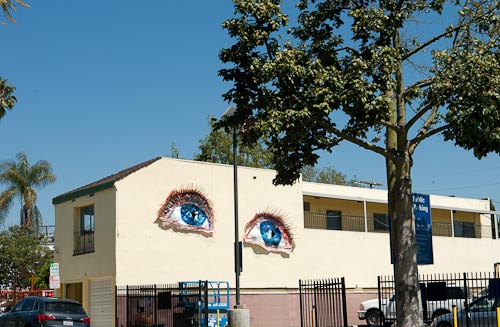
Fresh eyes on the Fountain Day School, as seen from Santa Monica Blvd.

The relief is comprised of 100 % recycled materials, some salvaged from local landfills.

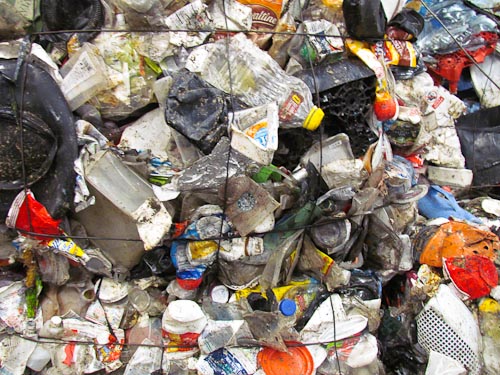
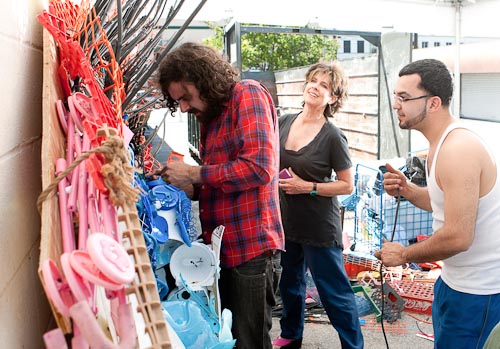
For a salvage artist like Deininger, access to a city dump — or any kind of waste management facility — means hitting the mother lode. Tom and I have worked on a number of “eco-projects” for companies like Fortune Magazine, and NBC Universal, but I had never accompanied him in his search for the perfect pile.We had an opportunity to “raid the refuse” at the Athens Services MRF (Material Recovery Facility) in the City of Industry, and you’d have thought the artist had won the California Fantasy 5. Tom found wonder—and possibility — in each passing container of junk. He extracted exactly what he needed, and began to plot: garden hose here, doll heads there — the perfect caldron of solid waste stew for a sculpture still in his head.

Through the artist’s eye

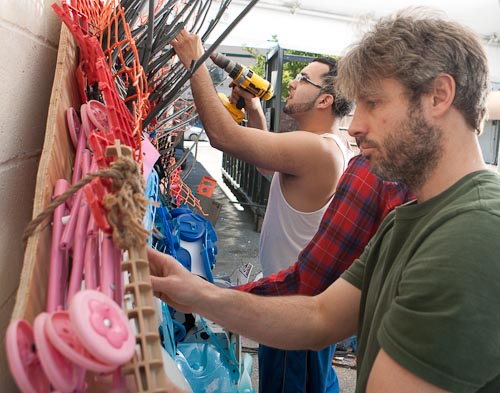
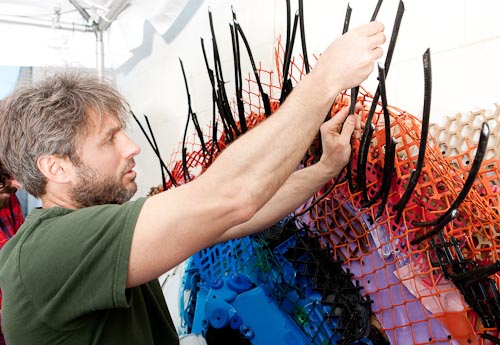
By pairing up oddball mixtures of color and shape, somehow, Deininger and his art assistants managed to smash, saw, and screw nearly a thousand minute plastic parts into a cohesive work of art. There is not a speck of paint on these two sculptures, though it may appear that way because of their clever use of color.

From a distance, the piece propecia shows the eyes of a toddler gazing upward, as if to a parent, or the future. A closer look reveals an intricate web of tossed toys and familiar objects that make up the image as a whole: action figures, baby strollers, pool toys, plastic trucks, and detritus from everyday life. A sobering visual message — underscored by the following facts from the eco-file:

  • Americans generate 10.5 million tons of plastic waste a year but recycle only 1 or 2 %
  • An estimated 14 billion pounds of trash – much of it plastic – is dumped in the world’s oceans every year.
  • Nearly every piece of plastic ever made still exists today.

For texture and depth, the artists incorporated tiny doll heads and plastic fencing into the larger structure.

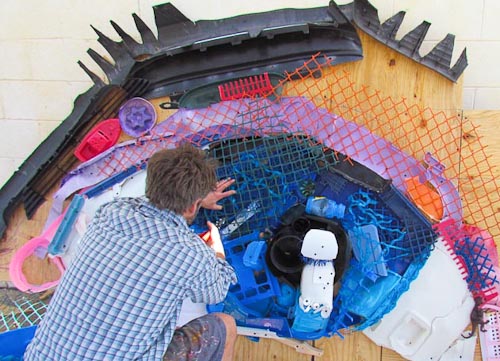
Tom began with the simple shape of his own child’s eye, and added hundreds of layers of shattered plastic to create dimension.

Deininger redefines the meaning of “color theory”as he has discovered a way to “paint with plastic.”

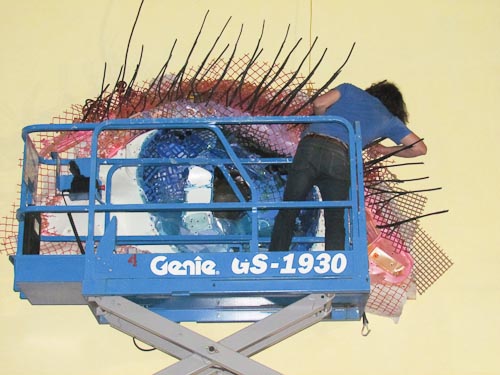
Late night installation via scissor lift.

Dump-recovered plastics: Deininger’s preferred palette.

Recovered insulated copper wiring served as bendable lashes.

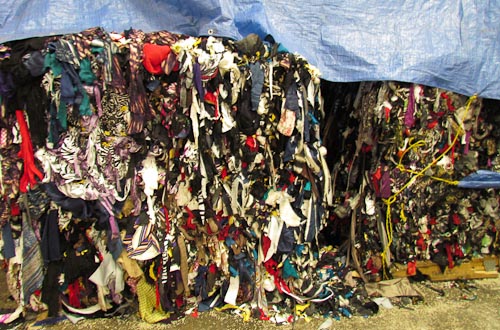
When Tom saw these massive fabric blocks at the dump, he said he wished he “could take them home.”


The artists chose a pink baby stroller (left) to serve as the base color for the left eyelid.

WEHO Council member Abbe Land surveys new work atop scissor-lift with artist Tom Deininger

More about Tom…

Deininger is a dedicated environmentalist who educates others about consumer wastefulness and resource overuse through his art. His award-winning installations incorporate trashed plastics, reclaimed wood, broken toys, furniture, and factory overruns – generally unrecyclable waste otherwise destined for city dumps. His work was recently commissioned by the Smithsonian Institution.

“Through the Eyes of a Child” is an environmental art project sponsored by Art on the Outside – a program developed by the City of West Hollywood’s Arts and Cultural Affairs Commission.  For more information, visit the WEHO Arts and Culture page.

A special thanks to: Mrs. Firestone’s Language Arts classes at Lindero Canyon Middle School in Agoura Hills, California, for enthusiastically collecting and contributing hundreds of discarded plastic caps for this project.

Photo Credit: Josh Kaplan, Executive Producer, Good Day L.A. on Fox 11.


Filed Under: Eco-Art Tagged With: art from trash, environmental art, from trash to treasure, Los Angeles Eco-Art, mural art, Tom Deininger, wall sculpture, WEHO art, West Hollywood public art

Art from the Ashes: Finding Beauty in California’s Devastating Wildfires

November 28, 2010 by Lonnie Lardner

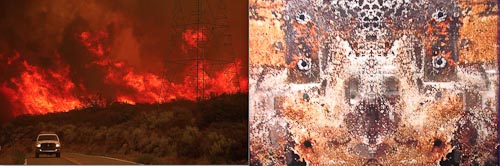
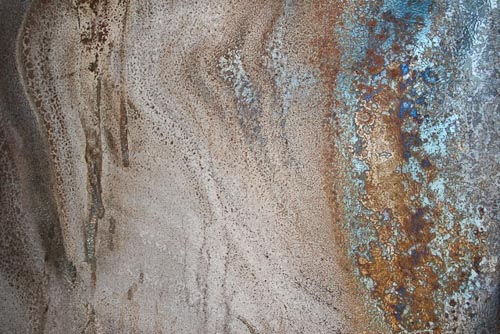
(Pic #1) Left: California Station Fire, photo credit: Genaro Molina, L A Times. (Pic #2) Right: Artwork from charred rubble from Santa Barbara Botanic Fire by Jonathan Chow

(Pic #3) Station Fire aftermath: Artists find meaning and elegance in debris. News photo credit: Luis Sinco, LA Times

As a former Los Angeles TV News reporter, I covered more wildfires than I would choose to remember–painful, sometimes deadly news events–that stick with me to this day. I can still see the flashes of horror and loss: panicked people–and pets–seeking safe ground, exhausted firefighters making one last run at a fierce wall of flames, as frightened neighbors pray their homes won’t be next. It’s almost impossible to describe what it’s like to witness that level of chaos and fear, but when I smell smoke, even today, it takes me right back to the scene.

So it was with a little trepidation I checked out a new art exhibit in Glendale, California. In a series of shows aptly titled “Art from the Ashes,” sculptors, painters, designers and craftsmen are invited to incorporate debris from Southern California wildfire sites into their artwork.

(Pic #4) Close-up: Cisco Home warehouse fire, South Central Los Angeles. Artwork/photo by Joy Feuer.

These fires tend to consume a staggering number of acres of mountain brush, and sometimes they insidiously fan out right through our neighborhoods. Last year’s Station Fire ravaged 250-square-miles of land, killed two firefighters, and destroyed 89 homes. On the face of it, there doesn’t seem to be much there to celebrate.

But artists see things differently. It’s what fascinates and inspires me. They see images, remnants, fragments and particles, in radically different ways. Once strained through their own filters, their interpretations can lead us onto new paths of understanding and appreciation.

(Pic #5) “Rights of Spring” installation from Station Fire by Ryan Wildstar

In “Art from the Ashes” we can see these translations as delicate, touching, and sobering reminders of the process of rebirth from a tragic thrashing of nature. In these ravaged communities and hillsides—if we’re amoxil open to it–we can find a strange beauty.

Check out the stunning patterns of burnt sienna and grays in Jonathan Chow’s photo of a corroded metal plant plaque recovered from the Santa Barbara Botanic Garden fire in May of last year (Pic #2, top), and the subtle patina that emerges from a rusted metal plate found and photographed by Joy Feuer (also founder of the non-profit organization, “Art from the Ashes”) in the Cisco Home Warehouse fire in South Central Los Angeles. (Pic #4).

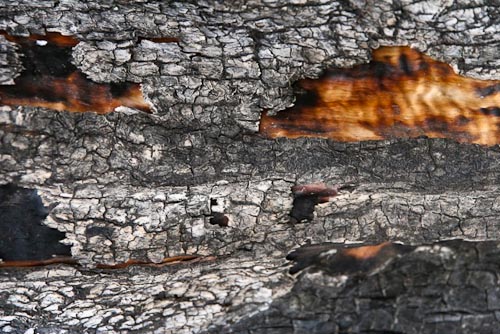
(Pic #6) Charred branch from Santa Barbara Botanic Fire. Artwork/photo by Joy Feuer.

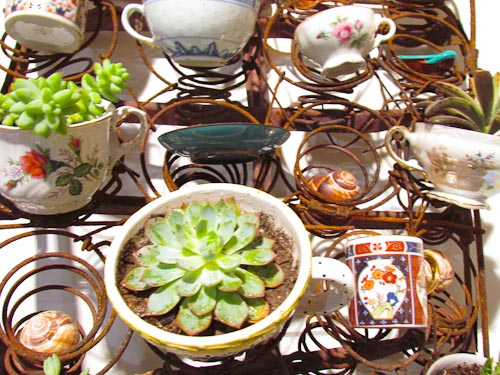
The simple patterns of cracked and charred branches from the Santa Barbara fire create textured rows of touchable shapes (Pic #6). Artist Ryan Wildstar transformed a burned, rusted metal spring frame recovered from a scorched Deukmejian Wilderness Park (a fire that burned 690 of the park’s 709 acres in September 2009) into a plant bed for native succulents (Pic #5).

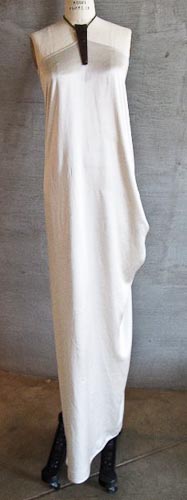
In last summer’s show, designer Corinne Grassini showed how fire can become sustainable, wearable art, by fashioning a minimalist white column dress with a decorative black neckpiece from charred debris salvaged from the park (Pic #7 ).


(Pic #7) Designer Grassini creates wearable art from ashes

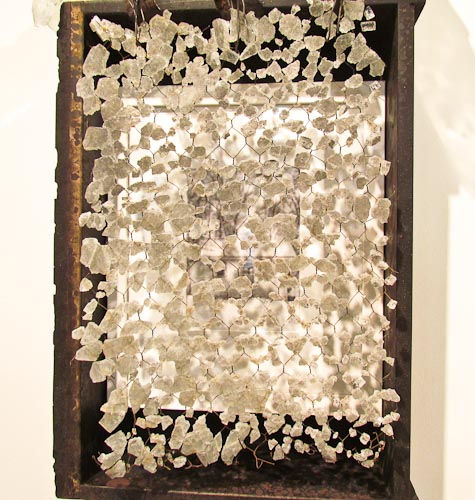
One of my favorite finds comes from the deliciously twisted mind of artist/actor Toby Huss — who places a displaced, scorched, wooden drawer up on the wall, under a snowy screen of shattered, melted glass and wire from two LA fires. (Pic #8) I couldn’t stop examining the clusters of glass, obscuring a printed image peeking from behind.

(Pic #8) Toby Huss crushed glass installation from two California wildfires

(You may know Huss from his work in film and TV. He’s one of my favorite comic actors, known for his quirky portrayals of Frank Sinatra, and for his voiceover work on the long running animated series King of the Hill. ) A profile on Toby planned for a future post in The Lardner Report.

Proceeds from “Art from the Ashes” benefits the communities and businesses devastated by fire. For more information, log on to: http://www.artfromtheashes.org


Filed Under: Eco-Art Tagged With: Art from ashes, art from the earth, artists create from wildfire debris, creative interpretation, Eco-Art, fresh approaches, Santa Barbara Botanic fire, Station fire, the artist's eye

  • « Go to Previous Page
  • Page 1
  • Page 2
  • Page 3
  • Go to Next Page »

Subscribe here:

Categories

  • Art Table Tips
  • Artist Spotlight
  • Creative Zone
  • Eco-Art
  • Found Art
  • Newsmakers
  • Quotes
  • Reflections
  • Travel
  • Uncategorized

Archives

Hey Brubeck, Take THIS.

The Alien And The Volcano: Why Do Our Brains Need to Make Order Out of Chaos?

Wait — So How Do YOU Choose a restaurant?

Meet Creative Voltage!

Sometimes Your Cat Just Makes The Art FOR You

2026: Kicking Fear to the Curb

Choosing Gratitude. But for a paintbrush?

Every Page Is A Treasure: Discovering Plastikcomb

Calling all artists — INKTOBER is here! Whaaaaa?

Art From The Ashes

One Click — One Masterpiece?

When Art F*cks With Your Head

The Perfect One-Liner

Portland: A Tale Of One City – Through Two Lenses

Happy New Year!

Allowing The Moment To Emerge

How Can A 5-Year-Old Be My Muse?

Stunning, Simple Beauty

An Unexpected Collaboration With Nature

Pathetic Shoe Obsession: WTF?

Copyright © 2026 · Dynamik-Gen on Genesis Framework · WordPress · Log in