The Lardner Report

Unleash your creative superpowers!

  • Home
  • Creative Voltage Website
  • Contact
  • Archives
  • About

Handwriting: A Lost Art — Found Again

August 14, 2011 by Lonnie Lardner

(Pic #1) “To-do” list with illustrations by artist Janice Lowry, 2003

Morgan Library showcases the beauty — and intimacy — of artist “LISTS.”

If you’re Generation Y, or in the latest group of tech-savvy kids who don’t remember life before texting, my hunch is good penmanship is not on your BFF list. In fact, TIME Magazine posits “we are witnessing the death of handwriting.”

According to an NPR survey, More than 8 in 10 Americans under age 60 currently use a computer at home or work. Most Americans say technology has significantly improved their lives, and they are demonstrating their enthusiasm through purchase power.

What does this mean? According to Steve Graham, a special-education and literacy professor at Vanderbilt University, the simple fact is — “Handwriting is just not part of the national agenda anymore.” As I see it, now the only professionals who consistently use handwriting in their work are doctors — and they suck at it.

But when you see The Morgan’s exhibition (from the Smithsonian’s Archives of American Art) you can’t help but be charmed by the personal, handwritten thoughts, inventories, and scribblings of some of the world’s most accomplished artists and writers of the last two centuries. And if you’re like me, you wonder if this personal method of record-keeping, list-making, and journaling will be lost — to endless pages of plebian helvetica medium font — forever.
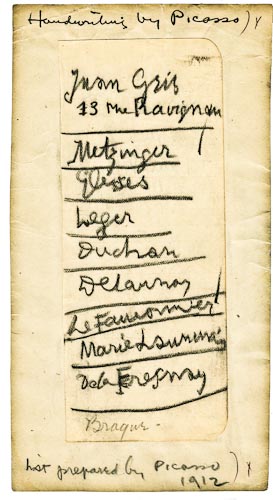
(Pic #2) Picasso’s list of recommended artists 1912

There’s something so intimate about seeing Picasso scratch out Marcel Duchamp’s name phonetically, (Pic #2) as he informally lists European artists he recommends for the 1913 Armory Show (including Gris and Leger) — the first international exhibition of Modern art in the United States. And of course it was Duchamp’s “Nude Descending a Staircase” that took the art world by surprise that year.

Assemblage artist Janice Lowry kept a journal for nearly forty years that filled 126 bound volumes. (Pic #1)  Peppered adhd with to-dos —“make plane reservation…. skin appointment,” and “get rain gutters” — she also weaves in dreams and random thoughts — each page thick with collaged images, paint, stamps, and stickers.
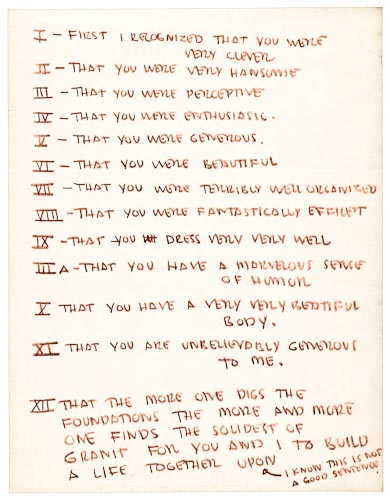
(Pic #3) Eero Saarinen lists his love’s “good qualities” 1954


Architect Eero Saarinen’s “list of good qualities” — written in all caps — for Aline Bernstein,  the woman who would become his second wife — shows a certain vulnerability, as he notes on the bottom, “I know this is not a good sentence.” (Pic #3)

In the sketchbook of Adolf Konrad, (Pic #4) we find an illustrated list of things the artist needed to pack for his trip to Rome and Egypt in 1962 — and on one page, he included a drawing of himself wearing nothing but his underwear.
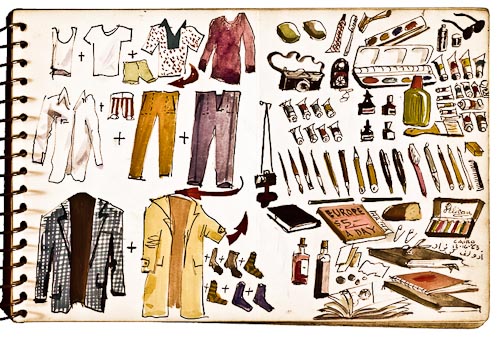
(Pic #4) Adolf Konrad’s “packing list” 1963

Mobile sculptor Alexander Calder’s handmade address book, circa 1930, casually lists the street addresses for iconic figures like Constantin Brancusi, Hans Arp, and other members of the Parisian avant-garde. (Pic #5)
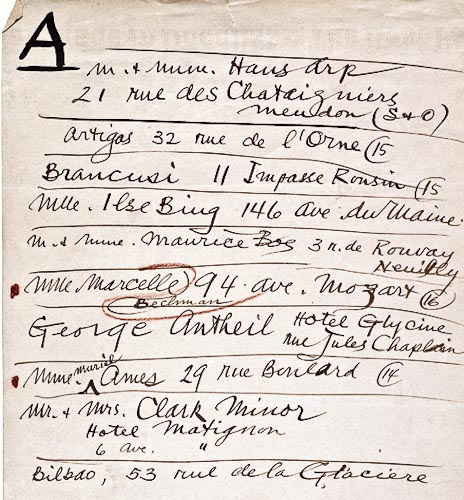
(Pic #5) Calder’s avant-garde 411

The exhibit, at The Morgan Library and Museum in midtown New York, also features notes from Lee Krasner, Elaine de Kooning, Grant Wood, and H.L Mencken. The experience sent me back to the first time I ever saw Henri Rousseau’s “The Dream” at MOMA. I stood there aghast, staring, in awe that I could finally see the original work I had admired since I was 10. Reproductions did not do it justice.

There’s something so human — so connective — about seeing evidence of an artist’s personal touch — right there on the paper or canvas in front of you. Graphologists will tell you handwriting can define a personality or reveal one’s true self-image. “LISTS” provides us with one more tool with which we can explore some of the art world’s most creative minds.

“LISTS” runs through October 2nd.


Filed Under: Newsmakers Tagged With: Adolf Konrad, Alexander Calder, Duchamp, Eero Saarinen, handwriting, Janice Lowry, lists, Morgan Library, penmanship, Picasso notes, printed vs: handwritten, the death of handwriting

Art From Above

July 31, 2011 by Lonnie Lardner

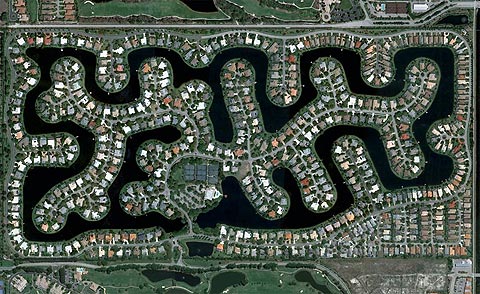
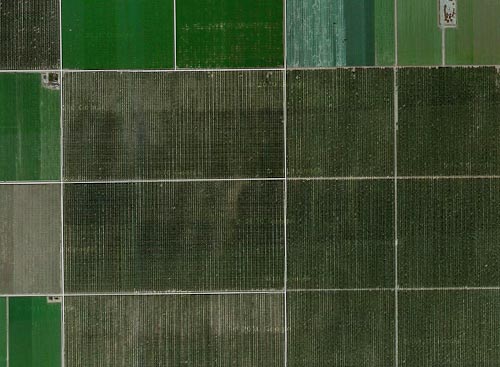
(Pic #1) Art from the air

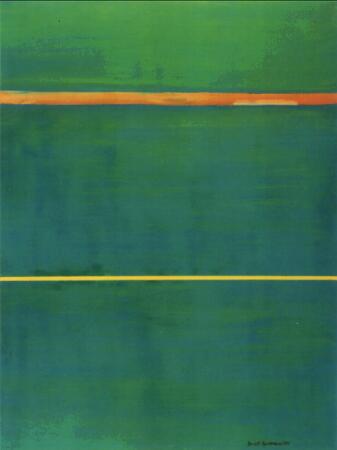
An original Rothko sells for millions.(Pic #5)  This artist gives his work away. On the other hand, while Rothko has millions of fans, this artist’s work is seen by tens of millions — every day. Meet Google Maps. The piece above is actually a screen grab from a Google Maps search of the area just outside Taft, California. It actually depicts a small section of one of the many farms in that agricultural town.

(Pic #2) The Ganges River Delta, USGS National Center for EROS, NASA landsat project science office

Earth: A Fragile Work of Art

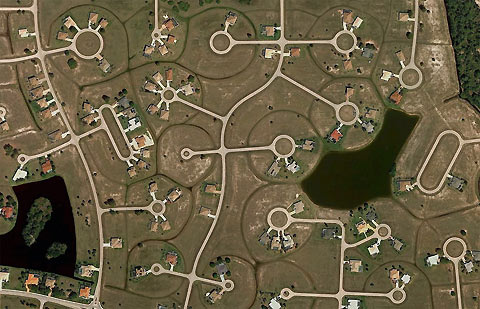
My point is this:  If even for a second, you opened your anticonvulsant mind to the possibility that this was an undiscovered masterpiece, then you can accept that there are beautiful pieces of art that you overlook every day. The images on this page are pictures of the Earth’s surface, taken with the aid of an orbiting satellite. In August of 1959, the first American automated spacecraft “Explorer 6” took the first photograph of our planet from above. It was the very beginning of satellite imagery. Today, over 2000 sats orbit the atmosphere — taking pictures — and making art.

(Pic #3) Human landscape: art from space

(Pic #4) Planned community -- unplanned art

(Pic #5) "Dionysius" by Mark Rothko, 1949

Filed Under: Found Art Tagged With: art from science, human landscapes, Rothko, satellite views, satellites create artistic patterns on earth

The Painted People

July 12, 2011 by Lonnie Lardner

Ethiopian tribes use their bodies as living canvases.

German photographer Hans Silvester spent over 5 years documenting the cultural diversity of the Omo Valley tribes of Southern Ethiopia. He’s compiled these breathtaking photos in a hardcover collection, and you’ll see some of his magical moments in the video above. It’s worth watching to the end.

The Omo people decorate their faces and bodies with their fingers, nails, or crushed reeds, and transform themselves into stunning works of art. They execute their vibrant abstractions quickly—painting themselves or each other two or three times a day. The rich geology of the region provides pigments of red ocher, green copper, yellow sulfer, and gray ash. The tribesmen also incorporate into their most personal masterpieces — nature’s finest accoutrements: wispy  feathers, brightly-colored flower petals, and rough-hewn twigs and leaves.

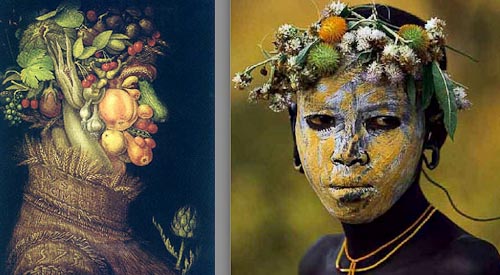
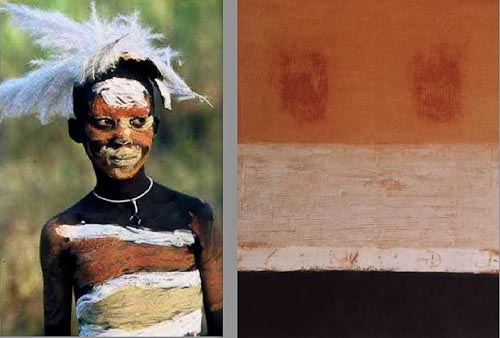
(Pic #1) Left: "Summer" painting by Giuseppe Arcimboldo, 1573. Right: Omo Valley Tribe girl with face painted, hair adorned with fruit, © Hans Silvester, courtesy Marlborough Gallery, New York.

In describing his mission, Silvester says “what’s most important for me is saving… as much as possible of this truly living art, which is mobile, changing, subject to infinite variation, and whose elements form a link valtrex between man and nature. It seems to me that our modern painting found the purpose of these elements, this simplicity, and used it as its foundation.“

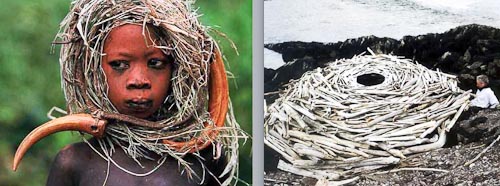
(Pic #2) Left: Painted Omo Valley boy, © Hans Silvester, courtesy Marlborough Gallery, New York. Right: Minimalist abstract painting by Father Bill Moore, 2010.

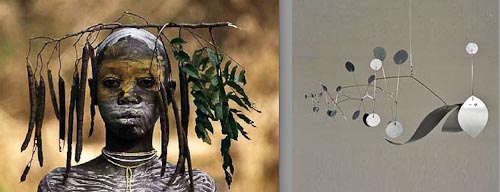
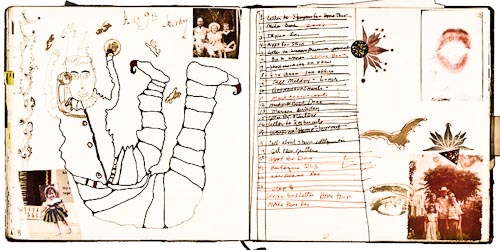
For me, the resemblance between the raw tribal art above and today’s most successful museum or gallery-shown art – is chilling. (Pics # 1,# 2, #3, #4) Worlds away, these inspired naturalists create their visual statements with no connection to Western culture. Most likely, they have never seen a Picasso, Goldsworthy or Miro.  But their masterpieces are authentic, original, and frankly, way too hip for the room.

(Pic #3) Left: Head-dressed Omo Valley girl, © Hans Silvester, courtesy Marlborough Gallery, New York. Right: Environmental art by Andy Goldsworthy, 2003

(Pic #4) Left: Head sculpture on Omo boy, © Hans Silvester, courtesy Marlborough Gallery, New York. Right: Steel mobile by Timothy Rose, 2001

Hans Silvester’s extraordinary work can also be seen in The Mediterranean Cat, Cats in the Sun, and  The Land of the Incas. A New York Times review of his work, The Painted People may be seen here.


Filed Under: Artist Spotlight Tagged With: Andy Goldsworthy environmental art, body canvas, Ethiopian tribal art, Father Bill Moore art, Giuseppe Arcimboldo, Hans Silvester photography, international art, living ar, Marlborough Gallery, Omo Valley painted people, Timothy Rose sculpture

  • « Go to Previous Page
  • Page 1
  • Interim pages omitted …
  • Page 66
  • Page 67
  • Page 68
  • Page 69
  • Page 70
  • Interim pages omitted …
  • Page 85
  • Go to Next Page »

Subscribe here:

Categories

  • Art Table Tips
  • Artist Spotlight
  • Creative Zone
  • Eco-Art
  • Found Art
  • Newsmakers
  • Quotes
  • Reflections
  • Travel
  • Uncategorized

Archives

09/27/2026 Los Feliz Wild Art Junk filled truck

Art? Or, Reflection Of My Mental Instability…

Hey Brubeck, Take THIS.

The Alien And The Volcano: Why Do Our Brains Need to Make Order Out of Chaos?

Wait — So How Do YOU Choose a restaurant?

Meet Creative Voltage!

Sometimes Your Cat Just Makes The Art FOR You

2026: Kicking Fear to the Curb

Choosing Gratitude. But for a paintbrush?

Every Page Is A Treasure: Discovering Plastikcomb

Calling all artists — INKTOBER is here! Whaaaaa?

Art From The Ashes

One Click — One Masterpiece?

When Art F*cks With Your Head

The Perfect One-Liner

Portland: A Tale Of One City – Through Two Lenses

Happy New Year!

Allowing The Moment To Emerge

How Can A 5-Year-Old Be My Muse?

Stunning, Simple Beauty

An Unexpected Collaboration With Nature

Copyright © 2026 · Dynamik-Gen on Genesis Framework · WordPress · Log in