Ethiopian tribes use their bodies as living canvases.
German photographer Hans Silvester spent over 5 years documenting the cultural diversity of the Omo Valley tribes of Southern Ethiopia. He’s compiled these breathtaking photos in a hardcover collection, and you’ll see some of his magical moments in the video above. It’s worth watching to the end.
The Omo people decorate their faces and bodies with their fingers, nails, or crushed reeds, and transform themselves into stunning works of art. They execute their vibrant abstractions quickly—painting themselves or each other two or three times a day. The rich geology of the region provides pigments of red ocher, green copper, yellow sulfer, and gray ash. The tribesmen also incorporate into their most personal masterpieces — nature’s finest accoutrements: wispy feathers, brightly-colored flower petals, and rough-hewn twigs and leaves.
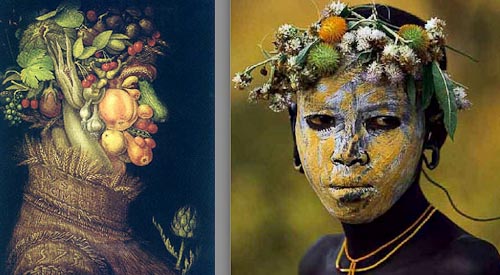
(Pic #1) Left: "Summer" painting by Giuseppe Arcimboldo, 1573. Right: Omo Valley Tribe girl with face painted, hair adorned with fruit, © Hans Silvester, courtesy Marlborough Gallery, New York.
In describing his mission, Silvester says “what’s most important for me is saving… as much as possible of this truly living art, which is mobile, changing, subject to infinite variation, and whose elements form a link valtrex between man and nature. It seems to me that our modern painting found the purpose of these elements, this simplicity, and used it as its foundation.“
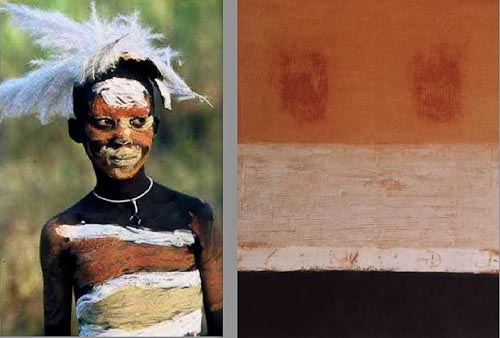
(Pic #2) Left: Painted Omo Valley boy, © Hans Silvester, courtesy Marlborough Gallery, New York. Right: Minimalist abstract painting by Father Bill Moore, 2010.
For me, the resemblance between the raw tribal art above and today’s most successful museum or gallery-shown art – is chilling. (Pics # 1,# 2, #3, #4) Worlds away, these inspired naturalists create their visual statements with no connection to Western culture. Most likely, they have never seen a Picasso, Goldsworthy or Miro. But their masterpieces are authentic, original, and frankly, way too hip for the room.
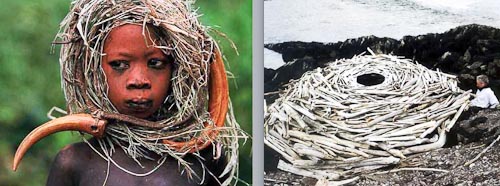
(Pic #3) Left: Head-dressed Omo Valley girl, © Hans Silvester, courtesy Marlborough Gallery, New York. Right: Environmental art by Andy Goldsworthy, 2003
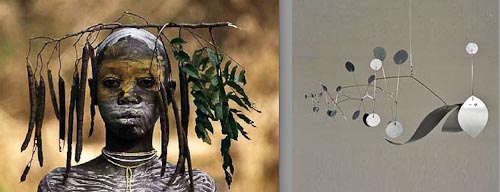
(Pic #4) Left: Head sculpture on Omo boy, © Hans Silvester, courtesy Marlborough Gallery, New York. Right: Steel mobile by Timothy Rose, 2001
Hans Silvester’s extraordinary work can also be seen in The Mediterranean Cat, Cats in the Sun, and The Land of the Incas. A New York Times review of his work, The Painted People may be seen here.

Once again you have broadened my horizon.
I found the video and photographs in your blog -breathtaking.
At the end you posted some photographs of works by Goldsworthy, Rose and Father Moore and I found your selections very interesting.
What an eye you have to take us beyond the obvious.
I also clicked on the link to the NY Times review of Sylvester’s work and had to disagree with the first line of the review in which Roberta Smith claims to find it “revelatory and disturbing.”
I personally found nothing disturbing about it whatsoever. but I do agree about her concerns regarding the art world potentially coming to the Omo people and what impact that might have on their culture.
I see this as their wonderful expression of their religious views & their connection to nature, the environment, animals etc. Probably it is also a way of expressing their love for one another? These people may understand E=Mc(squared) better than Westerners do?
Something we as westerners can not grasp, as evidenced by the very presence of this collection, is the impermanence of this art. The Dine (Navajo) people with their sand paintings and the Lakota (Sioux) of North America with their Sundance allow no photographs and upon completion remove all traces of the exquisite beauty which was created during the ceremony. As a westerner myself I find this practice liberating in that it forces one more and more to experience the moment, leaving behind our cultural mandate to live according to timetables and an eye to something else, something inevitably in the future. The initial difficulty clashes with our hard won ego but ultimately broadens our ability to apprehend the beauty of the everyday.
This is really fascinating. Who can judge what is beautiful and what isn’t? It truly is in “the eye of the beholder”. How lovely that these people are so creative and that their person is a canvas in which to express their inner life. Thanks Lonnie.