The Lardner Report

Unleash your creative superpowers!

  • Home
  • Creative Voltage Website
  • Contact
  • Archives
  • About

Through The Artist’s Eye

February 29, 2012 by Lonnie Lardner

What they see is not what we get.
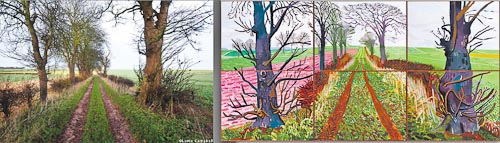
(Pic #1) Left: Scene that inspired David Hockney painting on right.

(Pic #2) (Left) Collage from a commercial catalogue of utensils - source for shapes in painting on right (Joan Miro)

(Pic #3) (Left) Mont Sainte-Victoire, today - source for numerous oil paintings by Paul Cezanne (right).

A lesson from Hockney, Miro, and Cezanne:

Artists show us fresh ways to see familiar things. They’re able to look at something – in nature, on the street, or in life – and interpret the scene or situation in their own very personal way.

To an artist – just about everything is interesting. And as the rest of us expose ourselves to new works of art – radical statements, or unique ideas — our own sense of  “what works” grows stronger.

On this page, we see how contemporary British painter David Hockney (Pic #1, right) takes a serene country scene and creates a colorful palette of pinks, tangerines and lilacs celexa that aren’t even present in the original photo – just one way an artist makes something his own.

Spanish painter/sculptor Joan Miro (Pic #2, right) extracts very specific shapes from his source material – cutout photos of metal utensils and medical instruments – and interprets them in quirky ways on canvas. It’s almost as if his new shapes – with their added detail and spiky lines — have developed a perky personality.
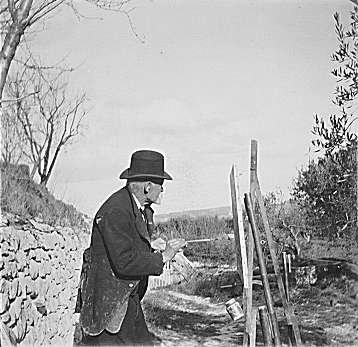
(Pc #4) Paul Cezanne on site - Mont Sainte-Victoire, 1906

Finally, French impressionist Paul Cezanne (Pic #3) became obsessed with interpreting one particular landscape in the South of France – the iconic Mont Sainte-Victoire – and painted it over 60 times. Each painting gives us something new – a different angle, an altered point-of-view, varied textures, or dramatically different hues. It’s something an artist can’t fight – and in fact, truly defines who he is. It’s also why artists are first to observe and reflect changes in society, culture, and taste.
Filed Under: Creative Zone Tagged With: artist interpretations, Cezanne, Hockney, Miro, what inspires artists?

Today’s Pic: The Art Of Urban Decay

February 28, 2012 by Lonnie Lardner

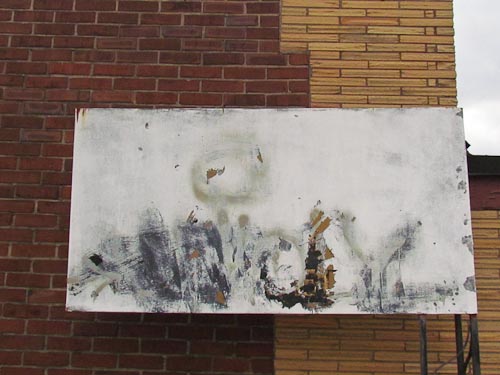
(Pic#1) Nashville sign: Finding beauty in decrepitude.

I may be obsessed, but these things just seem to find me. Driving through downtown Nashville yesterday, in a funky little section called the Melrose District, I passed a sign that truly seemed to scream at me. (Pic #1 and Pic #4) It had clearly seen better days, or maybe years, but its wear-and-tear left a gorgeous abstraction of rich browns, blacks, and  grey smudges.

I belted out a loud “STOP!” to my friend Susan, and bless her loyal soul — she hit the brakes. She didn’t understand why, but she knew I was on a mission. I bolted out of the car and grabbed the shot. She and her colleagues Sherri and Poonam might have been bumfuzzled, but were very polite about it.

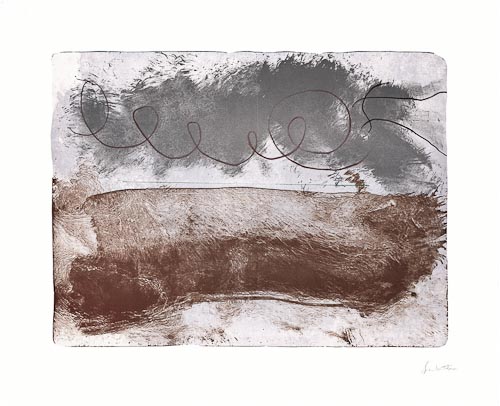
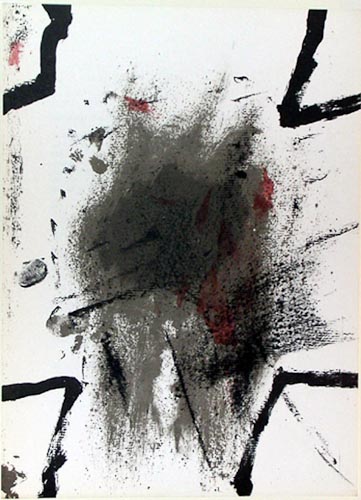
(Pic #2 ) Composition of Black, Gray and Reddish by Antoni Tapies, 1968.

I saw what could have been an acrylic abstract landscape  — a really interesting composition. (Pic #1)

(Pic #3) "Vuillard's Chariot" Painting by Helen Frankenthaler 2006

It reminded me of the work of the late Spanish painter Antoni Tapies, (Pic #2) and the iconic American abstract expressionist, Helen Frankenthaler (Pic #3).

But the artist, in this case — was nature. Who knows how many rainstorms or snowfalls ravaged the roadside ad, and how many layers of paper and ink were left in their wake. I just like the idea that the elements become artists too, and we benefit from  their unpredictable, repetitive action.

(Pic #4) Deconstructing Signage


Filed Under: Found Art Tagged With: abandoned signage, Abstract art, art from disrepair, beauty in destruction, billboards, Finding art everywhere, Nashville, urban decay

The Art of Teaching Art

February 16, 2012 by Lonnie Lardner

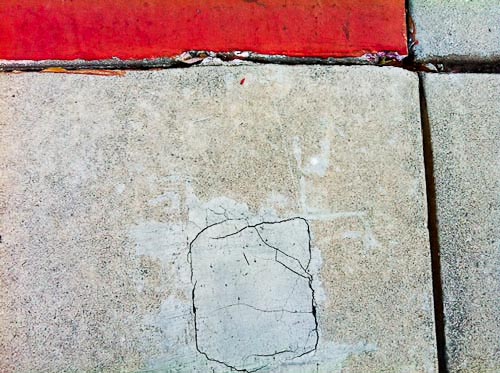
(Pic #1) My own "sidewalk show" found on the street in Calabasas, California

How my high school art teacher changed the way I view – everything.

I remember the day I understood what it meant to succeed at a task – specifically a school art project. It wasn’t the grade — nor the obligatory oohs and ahs from my parents — it had to be something I felt inside. I didn’t know this until I was 15 – when my 10th grade art teacher, “Mr. Printz” tossed out a question that made me cry.

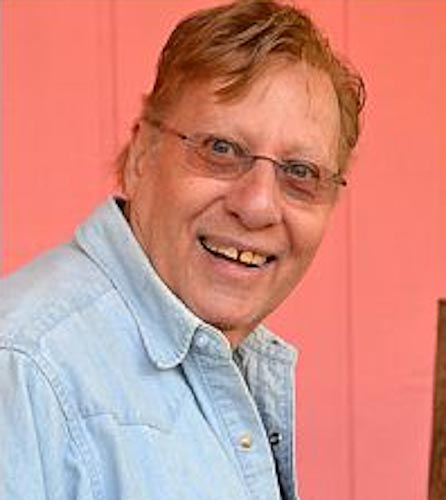
(Pic #2) Robert Printz, former Great Neck North High School Art Teacher

We were assigned a sculpture project, and I had chosen to make a plaster of paris oak tree in the middle of our living room in Great Neck, Long Island. I knew I needed something to hold the plaster onto the trunk, so I bought a roll of chicken wire and made what I thought was an adequate column, covered in traditional paper mache, and onto which I spackled the wet plaster.

Epic fail.

The plaster never dried, and by the time I had gotten the masterpiece to class, I had left a goopy white trail from my house through the halls of Great Neck North.  The project had become an oozing blob of white goo supported by a sickly crumpled wire foundation… resembling a little more of a Dr. Seuss character than I might have hoped.

I knew I had to submit the work, and had to speak about it.  I was paralyzed.  But Mr. Printz cut right through my consternation, and asked one thing:

“Lon, does this piece raise your blood pressure?”

At first I thought, well, yes, but only because I am completely humiliated.  I knew that wasn’t what he meant. He went on to explain that you know when a work is good when it sends you somewhere, speaks to you, makes you really feel something.

 I felt nothing.

Lesson learned: Appreciating a turn of phrase, a high note, a sidewalk show

From that day on, I have always tried to judge my work by this standard, and it has become a part of my psyche – an  internal mechanism of sorts — for appreciating and exploring art: in literature, in music, and on canvas.

It’s why I get so excited reading certain descriptions of nature in a Robert Frost poem, hearing the late jazz great Susannah McCorkle sing “Waters of March” or finding an unexpected artistic jolt on the sidewalk while I’m out for a jog. I’m now recognizing — and savoring — when I do feel my blood pressure rise.  It’s what’s supposed to happen when you do your best work, and appreciate the beauty of art around you.

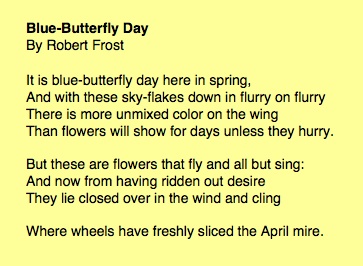
In describing blue butterflies, I love that Frost uses the phrase “flowers that fly.” (See poem above.) I still get misty when McCorkle slips into the Portuguese chorus, and just last week my blood steamed up when I saw this Mondrian-style cement block (Pic #1) on a sidewalk in Calabasas.

It’s a wonder I have time for anything else. Thank God for that, and for a sobering critique from Mr. Printz.

“Life is not measured by the breaths we take but by the moments that take our breath away.”

— Tina Adderholdt


Filed Under: Creative Zone Tagged With: art projects, feeling accomplished, knowing your best work, knowing your potential, life-lesson, observing art, Robert Frost, Robert Printz, self-criticism, Susannah McCorkle, teacher's influence

  • « Go to Previous Page
  • Page 1
  • Interim pages omitted …
  • Page 59
  • Page 60
  • Page 61
  • Page 62
  • Page 63
  • Interim pages omitted …
  • Page 85
  • Go to Next Page »

Subscribe here:

Categories

  • Art Table Tips
  • Artist Spotlight
  • Creative Zone
  • Eco-Art
  • Found Art
  • Newsmakers
  • Quotes
  • Reflections
  • Travel
  • Uncategorized

Archives

09/27/2026 Los Feliz Wild Art Junk filled truck

Art? Or, Reflection Of My Mental Instability…

Hey Brubeck, Take THIS.

The Alien And The Volcano: Why Do Our Brains Need to Make Order Out of Chaos?

Wait — So How Do YOU Choose a restaurant?

Meet Creative Voltage!

Sometimes Your Cat Just Makes The Art FOR You

2026: Kicking Fear to the Curb

Choosing Gratitude. But for a paintbrush?

Every Page Is A Treasure: Discovering Plastikcomb

Calling all artists — INKTOBER is here! Whaaaaa?

Art From The Ashes

One Click — One Masterpiece?

When Art F*cks With Your Head

The Perfect One-Liner

Portland: A Tale Of One City – Through Two Lenses

Happy New Year!

Allowing The Moment To Emerge

How Can A 5-Year-Old Be My Muse?

Stunning, Simple Beauty

An Unexpected Collaboration With Nature

Copyright © 2026 · Dynamik-Gen on Genesis Framework · WordPress · Log in